



Foreword
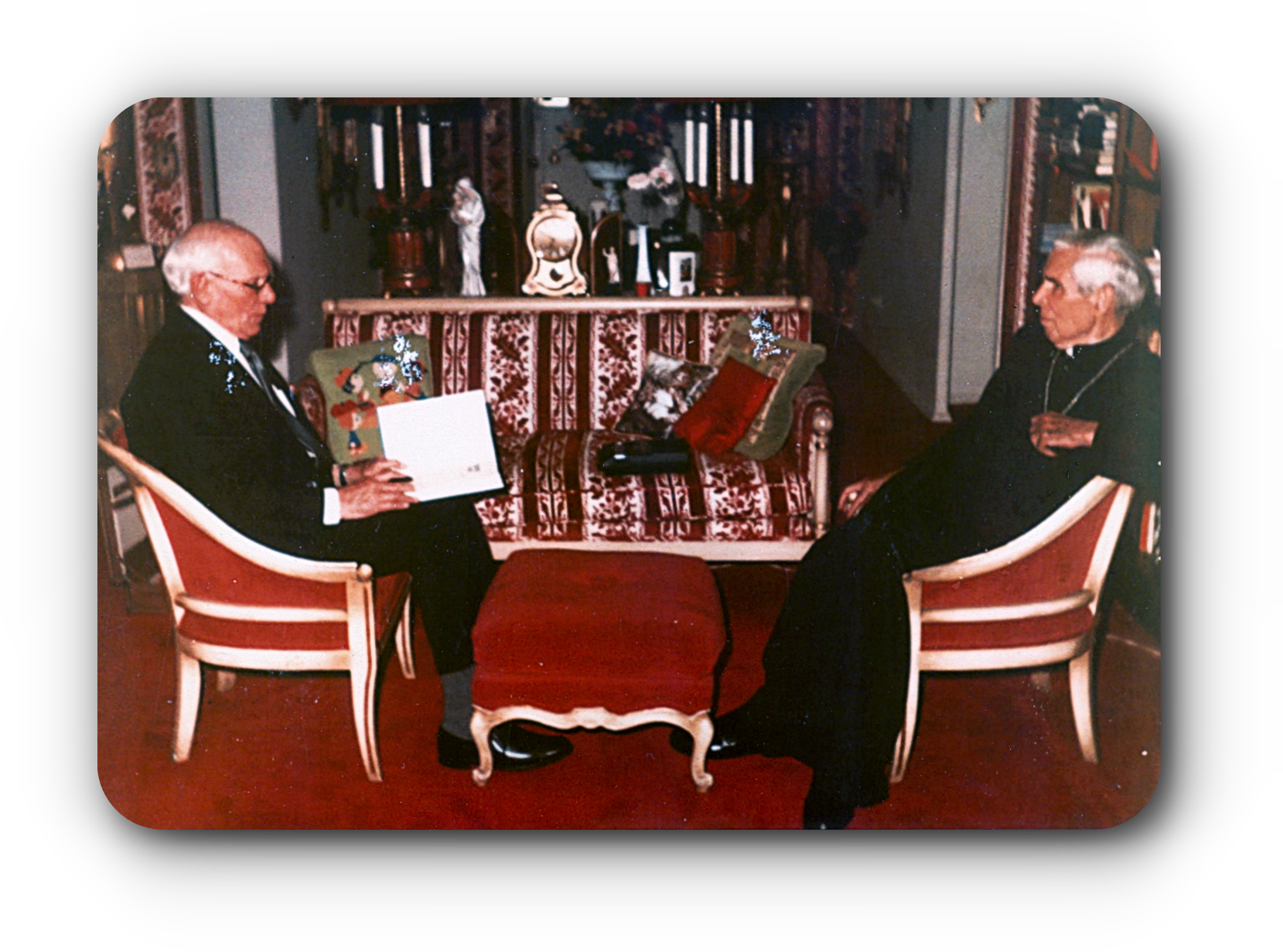
In May 1979, my father J.P. McFadden (who, among other roles, founded the Human Life Review) arranged for the first and only meeting between two great men: The famous British journalist Malcolm Muggeridge and the widely esteemed Archbishop Fulton J. Sheen. J.P. arrived with Muggeridge at the Archbishop’s Manhattan residence, armed with a simple cassette tape recorder and his Polaroid camera.
As you will read in the introduction below, the transcript never made it into print during the lifetimes of the three men. But in 2000, J.P.’s widow, my mother Faith, spearheaded the publication of the transcript in a pamphlet for our sister organization, the National Committee of Catholic Laymen. Only a few copies remain.
As Fulton J. Sheen is being beatified this year, in 2026, we thought it an auspicious time to share widely the luminous riches of their conversation.
I have always held Archbishop Sheen in special regard. On Good Friday, 1978, when I was sixteen, my late brother Robert (1960-1994) and I went to St. Agnes church, across from Grand Central station, where Archbishop Sheen was preaching the “Seven Last Words.” I wrote in my diary that evening that we “stood for hours,” but at least we were in the church. As the New York Times reported the next day:
“Thousands jammed St. Agnes Church and the sidewalks outside it yesterday to hear Archbishop Fulton J. Sheen speak at the traditional Good Friday service. . . . Inside the red‐brick church, the 1,200 seats in the balcony, and the 800 of the nave were filled, and worshipers overflowed into the side aisles, leaning against the confessionals, sitting on the carpeted floor and perching on the steps to the altar. Still a thousand others filled a basement room to watch on closed-circuit television. Outside, on the sidewalks of 43d and 44th Streets between Lexington and Third Avenues, loudspeakers carried the Archbishop’s address on the seven last words of Christ to thousands more.”
Sheen’s preaching had a deep effect on me, especially “what he said about Mary,” which led me to start saying the rosary daily. And then, the next day, again from my diary:
“You’ll never guess what happened! I went to St. Jean’s [St. Jean Baptiste, the church closest to the archbishop’s apartment] and who was one of the celebrants . . . Sheen!! I kept thinking, if only I could just meet him, touch his hand, I’d be blessed. At the end of the Mass I saw him, surrounded by women, and I stood where I was, almost panicky. When Robert saw me there doing nothing but obviously wanting to, he pushed me forward and I met the Archbishop! I was so nervous and excited that I didn’t kiss his ring, I just stood there, smiling. I believe he is a saint.”
I met Malcolm Muggeridge for the first time in 1979, during the same visit he made to New York for the meeting described here. He came to our apartment for tea—I remember my mother agonizing over how to prepare a proper English tea with actual tea leaves. Meeting him was like embracing a grandfather I’d somehow always known. He had a wonderful smile, and the most startling blue eyes—and again I thought to myself, this man is a saint.
Sheen and Muggeridge—two very different men, both in love with Jesus.
As I read the transcript again, these many years later, I marvel at the eloquence and the humor shared by all three men, and I am grateful to be able to share the following pages with a new generation of readers.
Maria McFadden Maffucci
__________________________________________________________________________
INTRODUCTION
In May of 1979, English author and gadfly Malcolm Muggeridge was visiting New York. An immensely gifted writer who had arrived at something like orthodox Christianity relatively late, partly through his discovery of Mother Teresa and her work, Muggeridge was one of Human Life Review founder James P. McFadden’s literary idols—and by 1979, to Jim’s great joy, also a friend.
Another profound admirer of Muggeridge (and early supporter of the Human Life Review) was Archbishop Fulton J. Sheen, the celebrated author and TV priest of the 1950s. Eighty-four years old and suffering from the heart disease that would kill him that December, Bishop Sheen had written Jim on March 18: “… you spoke of Malcolm Muggeridge. There are few men in the world for whom I have higher esteem. … I would be honored and delighted and inspired if the both of you could come to visit me at my apartment.”
And so it was arranged.
Who looked forward to this meeting more? Sheen was clearly the suitor. He emphatically expressed to Jim his great admiration for Muggeridge’s work (“Oh, to be able to write English as that man handles our language”). And as an old campaigner rich in converts, he no doubt longed to see Muggeridge safely into the Catholic Church.
Muggeridge, on the other hand, though well aware of Sheen’s reputation and successes, and fond of encountering and analyzing famous personalities, does not indicate a reader’s familiarity with Sheen’s writings. An Englishman, he may never have seen an episode of Sheen’s 1950s TV show Life Is Worth Living, or encountered a tape of one of his three-hour Good Friday talks at St. Agnes Church in Manhattan. In this transcript of their meeting, his graceful compliments to Sheen are made on behalf of his Catholic daughter-in-law, Anne Roche Muggeridge. Sheen seems to have surpassed Muggeridge’s initial expectations, both as a thinker and as a lover of Christ. After the Archbishop’s death, Muggeridge wrote Jim: “Many thanks for your letter and the cuttings about Archbishop Sheen which I was particularly glad to see as there was little about him in the papers here. I shall never forget our call on him and the talk we had. He was a man of God.”
As you read the transcript of this meeting between two great twentieth century authors and religious figures, you will see their strong but very different personalities expressing a sometimes surprising degree of agreement on matters religious and professional. Sheen the consummate TV showman, for instance, talks at length about the Church’s need to show-case people in love with Christ, as opposed to mere media professionals, if the Church is to make an impact in the public arena. Muggeridge, whose experience with Mother Teresa on the BBC backed up Sheen’s argument, emphatically agrees.
The two discuss famous converts familiar to both, like Graham Greene, Evelyn Waugh, Ronald Knox, and Clare Boothe Luce. They exchange thoughts on the mysterious power of suffering, and the meaning of the Eucharist. Finally, inevitably, the talk turns to why Muggeridge himself has not (yet) converted to the Catholic Church. Sheen, the master angler of souls, listens as Muggeridge unpacks a collection of his personal obstacles to union with Rome. Sheen separates the serious from the comparatively trivial, summing up Muggeridge’s position with the expertise of a master apologist. He concludes that his guest cannot be hustled into the portals of St. Peter’s at this juncture, and gracefully withdraws from the topic.
It is a fascinating performance, especially with the hindsight knowledge that Muggeridge would become a Catholic a few years later, in 1983.
There is matter for both laughter and meditation in this transcript of a conversation snatched from oblivion by Jim’s cranky cassette tape recorder (the batteries running a bit low, the occasional tail end of a remark drowned out by the sound of children’s laughter from a nearby window). Though Sheen had been weakened by recent open-heart surgery, his wonderfully sonorous voice, rising and falling, pausing for maximum effect, obedient, like a musical instrument, to the wishes of its master, still worked its magic. Running in and out of that organ music, Muggeridge’s engaging voice resembles a cathedral gargoyle come to life. Finally, acting as both audience and impresario, is Jim McFadden, the matchmaker of this fruitful meeting of two Christian minds.
So read and enjoy. “Even the smallest recollection of that day will be to me a source of happiness,” wrote Archbishop Sheen on hearing that Jim was sending him a copy of the tapes. We hope that you will feel the same way after you read this transcript. It captures an afternoon that, as Jim would say, was truly “marvelous.”
—Ellen Wilson Fielding, 2000
ARCHBISHOP FULTON J. SHEEN (1895-1979), Bishop of Rochester, NY from 1966-69, was the first “TV Evangelist”—his “Life is Worth Living” program in the 1950’s reached 25 million viewers and was the top-rated TV show in America. He wrote more than 100 books, articles and pamphlets, and he brought many people, including Clare Booth Luce and Henry Ford II, into the Church. Archbishop Sheen was declared Venerable in 202, and will be canonized on September 24th, 2026.
MALCOLM MUGGERIDGE (1903-1990) was a world-renowned British author and radio/television personality. A self-described “vendor of words,” some consider him the greatest journalist of the 20th century. He became a Christian apologist with his 1969 book, Jesus Rediscovered, in which he chronicled his journey from agnostic Socialist to believing Christian. His BBC documentary and book about Mother Teresa, Something Beautiful for God, introduced her to the West. Malcolm and his wife Kitty were received into the Catholic Church in 1983.
JAMES P. McFADDEN (1930-1998), was an editor, publisher and prominent Roman Catholic layman. He began his career at National Review magazine, where he became Associate Publisher. He was the founder of the Ad Hoc Committee in Defense of Life, an anti-abortion lobbying organization; the Human Life Foundation, an educational and charitable organization which publishes the scholarly anti-abortion quarterly, the Human Life Review, now in its 52nd year; and the National Committee of Catholic Laymen, which published the newsletter catholic eye from 1983-2012.
ELLEN WILSON FIELDING, author and mother of four, is a Senior Editor of the Human Life Review, and a freelance journalist. She was “discovered” by James McFadden through an exchange of letters when she was a college student at Bryn Mawr, and she joined the Review staff after graduation. Upon reading her early Review articles, Malcolm Muggeridge described her as “The Jane Austen of the Permissive Society,” and he wrote the Foreword to her book of essays, An Even Dozen.
SPECIAL OFFER! 50% OFF
|
LATEST ISSUE |
 |
 |
A Conversation
[Archbishop Fulton J. Sheen, Malcolm Muggeridge, and James P. McFadden greet each other. After some preliminaries and laughter ... ]
James P. McFadden: … I was just telling Malcolm earlier how much you influenced me when I was a child with your Catholic Hour broadcasts, and I can say—I won’t prejudice it by adjectives, but I have managed to influence my children. A great accomplishment nowadays.
Archbishop Fulton J. Sheen: Yes.
Malcolm Muggeridge: Yes. My children, John and Anne, are great zealots of Archbishop Sheen. They told me to tell you that they’re—my son married a Catholic girl, who is of very fine character. She wrote an account—a rather sharp account—of the situation of the Church in Canada, in her own name, Anne Roche1 [The Gates of Hell, 1975]. Anyway, they are great admirers of yours, and there’s a priest there, Father Marvin, has some cassettes of your addresses and they listened to them and they were greatly edifying … They told me to tell you that.
Sheen: Yes, we put out many of those all over the world, for retreats. And now I hope to make new ones because I’m going to give up [unintelligible]. I’ve been praying for years to drop dead at 80.
Muggeridge: Do you think it’s legitimate to pray for one’s death?
Sheen: Is it right to pray for one’s death? Well, I did in any case. Whether it was right or not, I didn’t get it. [laughter]
McFadden: [to Mr. Muggeridge] You beat me to it—he’s 84.
Muggeridge: Exactly. I know.
Sheen: Didn’t you write something about that?
Muggeridge: Yes, I did.
Sheen: Yes, that’s right. Yes.
Muggeridge: I wrote something about it. But I look forward very much to dying. I’m 76. I look forward very much to dying. But I suppose one has to just wait patiently for the moment. I can never understand anybody feeling appalled at the idea of dying.
Sheen: Well—
Muggeridge: A lot of people do.
Sheen: Sure; after all, when we are fearful of judgment and the door is being closed at the wedding feast, it’s enough to frighten people. The reason I had prayed to die at 80—I was afraid my usefulness would be over and I didn’t want to be a burden on anyone. So you never mount to a higher stage in life without a debt to a lower one. And then the Lord put me through a veritable crucifixion, this open heart [surgery]. I suffered pain that I didn’t know even existed, pain that was no longer outside of me, pain that possessed me, like an ocean overwhelming me. And outside of virtue, that’s the only educator in the world.
Muggeridge: Suffering.
Sheen: Yes.
Muggeridge: Quite right. I agree with that.
Sheen: I think when anyone wants counsel, either go to a saintly person or to one who suffers. And while I’ve been in that bed—I’m kept in it most of the time—I’ve instructed four converts and I’m now instructing the fifth … and I validated the marriage, in that bedroom, of my cardiologist and his wife . . . we had a nuptial Mass in the bedroom.
Muggeridge: Wonderful.
Sheen: So that was why I prayed. Now the only one—since we’re talking about praying—I only prayed to drop dead on the Feast of Our Lady, on a Saturday, or in the presence of the Blessed Sacrament. That’s my prayer now. The Lord may not grant it, which he oughtn’t.
Muggeridge: But yet you’ve made clear what you want. [laughter] But it’s a curiously contemporary attitude toward death that rather fascinates me, because I suppose that to people who have no idea of any sequel to our existence here, death is an offense to their egos really, because it’s their final frustration. They’re the people who are really scared of death, people who don’t believe there is any possibility of any sequel to it. And in a way it’s funny that they should, because if life is simply the time we spend here, it seems to me, that whether it’s a little longer or a little shorter is a bit of a nuance, really.
McFadden: So death is no longer a part of life for them.
Muggeridge: No, no.
Sheen: Scripture says in a short time, people fill many years. You’re finished when the Lord puts the line at the bottom of the cup. Of course death—death is from the devil. It’s the last death of detail. Therefore I think it’s a tremendous purification. I think many of us go clean before the sight of God as a result of having paid that last coin.
Muggeridge: Death?
Sheen: Yes. The Dream of Gerontius of Newman2—Here we spend our life being attracted to divine love, and at the same time always a tremendous sense of deep unworthiness, and that tension, that dialectic between the two, is where Newman puts the various purgatories? Like a lover meeting someone whom he has offended.
Muggeridge: And he has no excuse.
McFadden: Where in Newman is that? I missed that.
Sheen: The Dream of Gerontius.
Muggeridge: Yes. He was a considerable poet, wasn’t he? And he was a wonderful prose writer.
Sheen: And he suffered a great deal.
McFadden: He certainly did.
Sheen: He suffered in the Church.
Muggeridge: From the Church.
Sheen: From the Church, which can be a very bitter form of suffering.
Muggeridge: So did Ronnie Knox.3
McFadden: [to Archbishop Sheen] So have you.
Muggeridge: I suppose in a way there’s a logic in that too, that the Church should make its most distinguished children suffer.
Sheen: The cruelest words in sacred scripture are, “You’ve already had your reward.” But they’re true. Yes. It’s to go up to heaven unpaid—
Muggeridge: … with nothing in hand. [laughter] I quite agree. It’s a somber thought.
Sheen: You must be a mystery to many of your colleagues when you tell them how indifferent you are to death.
Muggeridge: It irritates people rather at times. I was thinking—Because I personally think that our mortal existence, apart from its marvelous mystery and truth, is an overrated thing, I mean just as an existence. I rather like Teresa of Avila4 who said, it’s like a night in a second-class hotel. [laughter] And you can’t be too upset about that. It’s a vivid phrase: “a night at a second-class hotel.” But anyway …
McFadden: Not even two nights.
Muggeridge: No, and not in a nice hotel, but a second-class hotel. [laughter] I think one of the many attractive things about Christianity which is very unfashionable now is its contempt for our mortal existence as such. But I was saying today that the thing going on in the world at the moment that fascinates me most is this extraordinary recrudescence of Christian faith in places like Soviet labor camps. It’s utterly fascinating—of course Solzhenitsyn5—but there are many, many more, you know, names that are little-known, but—All these people say the same thing. Solzhenitsyn said it, they all say it. They say that in these camps, you know, in this terrible situation, you are confronted with the choice of saving your body or your soul. If you decide to save your body, and to hell with your soul, you lose your body as well as your soul. If you decide to save your soul and to hell with your body, you derive therefrom the strength to save your body as well. And not only that, but you have this incredible joy. But I think of it, really, as those very inscrutable words in the New Testament, whoever hates his life in this world shall have his life—and whoever loves it will lose it. This is an exact fulfillment of that saying, isn’t it? But it’s very alien to contemporary thought, because they can’t bear any denigration, because it’s all they’ve got. Maybe if you only had a night in a second-class hotel, you wouldn’t be indignant about ii being a second-class hotel, you would say “Not at all. It’s a very fine hotel. It hasn’t actually got five stars in the Guide Micheline but it’s very good.” [laughter] You can only despise it to the extent that you see these other possibilities. Don’t you agree?
Sheen: I do agree of course. And this is one of the difficulties one has in evangelization in the 20th century, is putting that alternative that Our Lord brought out in the Parable of the Virgins. The door being closed, too late. We’re given our opportunities. Yet He is the God of the second chance. Where we have life. Millions of chances. How I’ve known that. For example, I correspond regularly with a nun in London, Hyde Park. I was a curate in St. Patrick’s Oval Square—
Muggeridge: That’s the one that was blitzed out, isn’t it?
Sheen: Right off, between Charing Cross Road—
Muggeridge: Yes.
Sheen: —and Oxford Street.
Muggeridge: But I think it was blitzed, wasn’t it, in the war?
Sheen: Yes, it was.
Muggeridge: That’s right, it’s gone.
Sheen: A bomb fell through it.
Muggeridge: That’s right, fell straight on it.
Sheen: During my years in Europe when I was a university student, I worked there in the summers and I preached there weekends. I picked up a girl one morning at a church door, and she said “Where am I, where am I, Father?” I said, “Oh, are you a Catholic?” She said, “I was. Not any more.” So I made a cup of coffee for her, because she’d been exposed to London’s January air. And I asked her to come back again. She said, “Provided you don’t ask me to go to confession.” I said, “Very well.” She said, “I want you to promise me faithfully you will not ask me to go to confession.” I said, “I promise you faithfully not to ask that you go to confession.” She came back that afternoon … I said, “We have a Rembrandt in this church—would you like to see it?” As we walked down a side aisle, I pushed her into the confessional. [laughter] I’d only promised her I wouldn’t ask. Well, she’s been a nun all these years. That was in 1923. And she had a second chance. That’s what we deal with.
McFadden: Does it strike you as devilish that the Church has so—what would the modern word be—de-what confession? De-emphasized?
Sheen: De-emphasize, yes.
McFadden: Or worse than that.
Sheen: Well, the whole concept is, you see, today nobody is a sinner. It used to be that we alone believed in the Immaculate Conception. Today everybody is immaculately conceived. [laughter]
McFadden: Yes.
Muggeridge: That’s quite true. Everybody’s sinless.
McFadden: That’s right. Everybody’s sinless. Not just Mary, all of us.
Muggeridge: Even that lovely hymn of Newman’s, they won’t have it anymore—”Lead, Kindly Light/ Amidst the encircling gloom.” We can’t have any “encircling gloom.” It’s very interesting. And of course the more they pursue their course, the more melancholy they become. [laughter] It’s the genius of Christianity, really, to present a somber picture of earthly existence and make everybody happy.
Sheen: A great psychiatrist from the Kansas Institute of Psychiatry, Karl Menninger, wrote a book, Whatever Became of Sin?
Muggeridge: Yes, I saw it.
Sheen: The priests and the ministers gave it up, and then he said the jurists picked it up and it soon became a cry, and then the psychiatrists picked it up and it soon became a complex.
Muggeridge: And now they can’t sin. They’re in the same dilemma as poor Graham6 is. Can’t sin because there isn’t any sin.
McFadden: He’s a special case.
Muggeridge: Graham Greene’s great grievance is that he has never been able to sin. In fact, the last time I saw him, he was grumbling about the Church having removed these orders such as eating no meat on Friday and you must go to Mass. He said that now there is no more pleasure in anything because there is no pleasure in breaking the rules because there aren’t any rules. [laughter] So there’s a funny kind of grievance. But in a way I see his point. Why is it—it’s always interested me that the two most distinguished Roman Catholic converts among writers, I mean Evelyn Waugh7 and Graham Greene—
McFadden: Plus Knox.
Muggeridge: Hmmm?
McFadden: Plus Ronnie Knox
Muggeridge: Ronnie, right. So the three most distinguished converts—certainly Graham Greene, and even I would say also Ronnie—suffered acutely from boredom. How could that be? Graham admits it was the torment of his life. And Waugh too, he used to go off to the cinema by himself. I always think that’s a sign of an utterly—to go to the cinema at all is a most bizarre thing to do, but to go there by yourself—And Ronnie was more melancholy than bored. But why should those three Protestants, gifted men, have to been made to give into supreme boredom.
Sheen: Well, Knox I know about. Knox was given poor appointments.
Muggeridge: Oh yes, he was.
Sheen: I was a colleague with Knox at St. Edmonds. I taught theology.
Muggeridge: When he was there?
Sheen: When he was there. He was very unhappy. Oh, he was so transcendent to the other men that were there in knowledge … he was very humble. So he was quite unhappy. But maybe we don’t become very emotionally happy when we come into the Church. We get across [or a cross, ed.], and happiness is rather deep.
Muggeridge: I knew Ronnie a bit, and I disagree that he was unhappy. I think there was a basis of serenity in his life, but only to a reconciliation with life. I also knew—I know Graham—he was a close friend of mine. Waugh was a close enemy of mine. [laughter] But the thing about them that I always felt was that though they were both—I mean Evelyn was and Graham is—they really were both good men. Graham Greene is a very good man. He wants goodness to thrive. And Evelyn Waugh tried desperately hard to be utterly vicious, but he was unable to succeed. He had this queer kind of saintliness in him. But I always felt that they had the wrong end of the stick, in a way. Pardon an impertinence of mine, but in the case of Waugh, that somehow this Church would sustain the disintegrating Western world. I don’t see why it either could or should do that. If it was disintegrating it is disintegrating for very good reasons, and there would be no point, even if God wished to allow it to be propped up—I mean, Graham’s case—he had this extraordinary fascination for all the—what would seem to an outsider to be—the paltry side of things. Like magic. Magical things. He was tremendously excited about Padre Pio’s stigmata.
McFadden: Not his flying?
Muggeridge: No, no—his stigmata. In fact he wrote a very funny play about that actually, a very clever play, called “The Potting Shed,” about—in a free-thinking household, a miracle occurred.
McFadden: I saw it in London.
Muggeridge: Yes, and they did everything in their power to suppress it, because they were ashamed of the fact that this should have happened in a good, free-thinking home—But it’s a very clever idea. But it was that side of it that appealed to him. And he would get very impatient at any suggestion that Christianity was about something called love or anything like that. He would just brush that aside. It had to be this extraordinary—and that’s why, in The Heart of the Matter, The End of the Affair, the man is tormented because he can’t now go to Mass. He’s invalidated the possibility of receiving the Sacrament.
McFadden: That’s The Heart of the Matter. Scobie.
Muggeridge: Scobie, that’s right. But it’s the kind of legalistic aspect of that that appealed to him. And he would hate the idea of simple—well, someone like Mother Teresa—it would make him irritated, because he would feel that it was making it too simple.
Sheen: I wonder if they had a deep personal encounter with Christ or was it with the Church in which Christ …
Muggeridge: I would say the latter.
Sheen: Yes.
Muggeridge: And that’s no good, really, is it?
Sheen: No.
Muggeridge: The essence of it is the personal encounter.
Sheen: The Church is made up of many who have not had this personal encounter with Christ.
Muggeridge: So there’s no—it doesn’t—it’s not a living—
Sheen: That’s right. They’re not in love, in other words.
Muggeridge: So that a man like Evelyn Waugh, his heart could be broken by seeing that this Church, that the social implications of it, which are expressed in Brideshead Revisited, and so on, that they’re not going to come to pass, and the whole thing has let him down. And in Graham’s case, that the magic doesn’t work; that it’s not enough just to be able to take the Sacrament and then this and that happens. That isn’t the thing that’s the basis of it. That’s probably the reason. And then if you do that, then this boredom would come in because there would be no—I mean, the anti-boredom is this living relationship with Christ which makes each human being a wonderful person, whoever they may be. Mother Teresa says every single person is Christ, but of course she is very funny, really, because she doesn’t believe you should abuse people, which I rather enjoy doing [laughter] but she doesn’t. But when she wants to abuse anybody, she says of someone, “He’s Christ in very distressing disguise.” [laughter] Wonderful.
Sheen: Isn’t that beautiful! Many of course in the Church, they know about Christ, but they don’t know Christ, and particularly the Passion of Christ, the Cross … I find that when St. Paul went to Athens, he prepared that discourse because he quoted two of their poets.
Muggeridge: So it was a set piece.
Sheen: Yes. And not only that, he reviewed the lessons of psychology that said, Start with something familiar to them, and so he spoke of their statuary and so forth. He spoke of creation, providence, government of nations, resurrection as an anastasia, whatever that was. He never mentioned Christ on the Cross.
Muggeridge: And it was a flop.
Sheen: It was a flop!
Muggeridge: Very interesting. The only flop he had, really.
Sheen: The only flop in his life. He only had two converts, Demaris and whoever it was [unintelligible]… and then he walked the 30 or 40 miles to Corinth, and he must have thought over why he failed. And he wrote to the Corinthians: “From now on, I am resolved to know among you nothing but Christ and Him crucified.” And there was no church established in Athens, and we have no record of the letter being written to the Athenians by Paul.
Muggeridge: It was a washout.
Sheen: Yes, the whole thing was a complete washout.
Muggeridge: The only address that he fully prepared. It’s very interesting.
McFadden: Yes, I never thought of that. I knew that he’d prepared it, but I never thought of the failure part of it.
Muggeridge: You know, I did those programs with Alec Vidler8. We had a marvelous discussion. He’s my oldest friend, who’s an Anglican. I would say he is really the last Anglican that’s in existence. He has all this extraordinary combination of utter skepticism with a sort of wonderful Christian love in the end—which only the Anglican church produces—unutterable skepticism and unutterable love, and the two together. But he and I went round following the courses of Paul’s journeys—it was a very successful television series. It was enormously wonderful, for me. And when we were doing that Athens bit, I made this point. And I said, “I’m sure these men were a lot of loathsome dons—university dons.” And Alec of course had been a university don all his life; he said “No, no, no, they were journalists.”[laughter] And then we had this terrible quarrel as to whether these men—I said, journalists don’t know anything about anything, they couldn’t possibly know about these points that were raised.
McFadden: I’m afraid you’re right.
Muggeridge: Yes, I think so. One was very, very conscious of that. It’s always wonderful when you find in someone like Paul, who was one of the greatest men who ever lived, that he could misunderstand a thing totally. It’s very comforting and very good. And he did, he utterly misunderstood the situation. It’s what everybody would say now, if we want to appeal to academic theorists, we must approach them in academic terms. Completely nonsensical. That’s the fallacy, isn’t it, of religious television. They’re always trying to present religion and Christianity in terms of something else.
Sheen: Yes, it becomes very often a by-product—
Muggeridge: Yes—
Sheen: —of something else that was said.
Muggeridge: And the interesting thing is that they can’t seem to learn is that whenever you do—for instance, take Mother Teresa. The first time she was put on television … she just came on and talked, and answered some questions. And she doesn’t ever say anything of any startling originality. But you know, letters poured in, contributions poured in for her work—everything like that—and they—I remember so well everyone said, Why should this be? They were completely flummoxed as to why this should be. I said, if you put a Christian on, if you really get a real Christian … of course it was true of your [Sheen’s] broadcasts, perhaps the most effective things of the kind that’s ever been on television, because you proclaim your faith in your own way, in your own terms. And that is all anybody can ever do on television. And all this kind of setting up of programs—I tried in a lecture to invent a—The devil having tried his three temptations, had a guerre de force, which was that a big tycoon from Rome was passing through the Holy Land—and Our Lord’s ministry was being conducted, and thought, Marvelous stuff. We’ll get this man to Rome and put it on in primetime and it will be marvelous, you know, and we’ll set it all up and trim him up a bit, you know, and we’ll get some people over from Athens, some philosophers, so that there’s no prejudice—and then of course it never occurred to the tycoon that he would refuse it, but he did refuse it, and he was lucky he did, because it was explained there was going to be no advertising, no vulgar advertising, just a very highly regarded firm of public relations consultants was going to sponsor it. And they were called “Lucifer, Inc.” And so that the program was going out by courtesy of Lucifer, Inc. So it was lucky he refused it. [laughter]
Sheen: Apropos of not using the direct approach, I have often in the course of years known people who reflected on the television shows. One woman said, I’m a convert of yours, and I was converted by one of your television shows. Well, I was anxious to find out which one it was; I must use this approach again. One of the shows was, I announced the death of Stalin. I gave a telecast a week before he died. And I went through Shakespeare, Brutus and so forth, Mark Antony’s oration, and there was no address at all, reference to Christianity. None whatever. And I was merely speaking at the end, of the death of Stalin. She said it was the death of Stalin. Now it was not, therefore, the message. It was an emanation of the spirit that goes when you start the right way, so all the power came from outside, and that’s how her conversion was effected.
Muggeridge: Very interesting.
Sheen: Yes, not by anything I said, because if there was anything uncalculated to convert a person, it would be the death of Stalin. [laughter] Predicting his death. And then when it happened the week afterwards, conveniently, I was deluged by the press. “How did you know?” Of course I didn’t know. Except I knew he was mortal. I understand that several members of the—the children of the Comintern9 have been baptized.
Muggeridge: This wouldn’t surprise me at all.
Sheen: The Russian archbishop told me that.
Muggeridge: I wouldn’t be surprised at all. There is a fantastic revival going on there. It’s the most interesting thing happening in the world. Of course the media are not interested in it for that reason. But it is the most important thing happening in the world, because after all, this is the first regime in human history which was dedicated totally to atheism and materialism, first. They’ve had a 60-year run of total power, controlling everything—what people read, what they think, what they say, what they are, where they live, everything. And it would have seemed—I must confess I was there as a young journalist in 1932 when I was 27, and I would never have believed that with that immense indoctrination going on night and day, and the regime being in material terms highly successful, that you could possibly have come out of it, what has come out of it which is this utterly fantastic recognition of the Christian alternative. I interviewed a chap—a Soviet writer called [Anatoli] Kusnyetsov10[unintelligible] … He sensed—he said to me in so many words, he said: When you are confronted with absolute power there is nothing you can respond with to it except the absolute love of Christ. And he made the point that it is not even something you choose: it is literally the only thing you’ve got. So that in achieving this total dedication to materialism and atheism, they provide the perfect circumstances, they force people to follow Christ. So one has to see the hand of God in that. And there’s another point of it that fascinates me too; this man also said to me that the biggest mistake that Stalin made from the point of view of the regime was not to ban the works of Tolstoy, which they never did, because he was such a great Russian writer. But actually, take Tolstoy’s short stories, his Confessions, Resurrection. This is a perfect exposition of the Christian faith in the simplest possible terms, which to Russian people, since all the rest of the reading possibilities were infinitely dreary books called Slag or Cement or some-thing like that [laughter] this just had to be manna from heaven, these short stories of Tolstoy’s. And I agree with Kusnyetsov. I think that was probably the biggest mistake he [Stalin] made. Because it prepared the way—I mean that’s why I believe your story, your man’s story of the two children. It is precisely those kids brought up in that particular environment who are, of all elements in the Soviet population, going that way. They’re scared of it.
McFadden: They made a subsequent mistake, too: they did not kill Solzhenitsyn.
Muggeridge: Absolutely. And furthermore, now the fatal in all that they’ve done is to allow the novels of Dostoevsky to be published.
Sheen: Yes.
Muggeridge: They print them in gigantic editions, a million copies and they are snatched up. They go into the bookshops and the following morning they are gone. You would cry your eyes out—
McFadden: Yes, I would, but it’s for a good cause.
Sheen: Yes. Because all of his novels revolve around good and evil.
Muggeridge: Of course they do. And it is that he is the great anti-Marxist. The Devils [or The Possessed, ed.] is a classic story of devils at work in the guise of liberalism and anarchy.
Sheen: I remember one of his passages forecasting all of this communism. He said, “Read to me the passage of Luke.” And it was read to him the passage of the Lord driving the devil out of the young man into the swine. He said, “That’s my Russia, full of devils. And the day will come when the devils will be driven out of the swine, and they will be pushed back and back into the sea, where they will be drowned.”
Muggeridge: That’s in The Possessed.
Sheen: In The Possessed, yes. “Russia will sit at the feet of Christ and learn His gospel.”
Muggeridge: That’s right. Now this vision is presented to the Russian people in incomparable language, exciting narrative. I mean, if you took all the money that’s been spent by the Voice of America, the Overseas BBC—billions and billions of dollars— [laughter]
McFadden: To tell them about Kissinger and Le Due Tho.11
Muggeridge: That’s right, that’s right.
McFadden: You’re right.
Muggeridge: These books of Dostoevsky snatched out of the shop by people, terribly printed and everything, and they’re doing the job.
McFadden: Yes.
Muggeridge: And of course the danger is—and this is a danger that very few people realize—the danger is that the regime will take over Christianity. Because I feel it’s a very real danger, because Marxism in the Soviet Union is a joke, and Solzhenitsyn says that and I am absolutely certain it’s true.
McFadden: No Marxist is—
Muggeridge: No, they have been so indoctrinated—They’re so bored with it, it’s from their point of view of lamentable consequences. And therefore the temptation to the regime to take over Christianity, to use it as the ideology of the regime … is a grave danger. And people, Russian Christians, are very aware of it.
McFadden: But I wonder whether the devil can handle the crucifix, I really wonder.
Muggeridge: I like irony to be complete, and I would very much like [unintelligible] to take place at exactly the same time as all this ludicrous dialoguing with Marxists by Jesuits induces the poor old Vatican to bring out an encyclical called, you see, De Necessitati Marxisme—to have these two events coinciding. It would be terrific.
Sheen: You know, the bishops publish a letter every year. One of the bishops received an advance notice from our conference in Washington and he sent the letter to me, a proposed draft of a dialogue with Marxism. I read it through. I know Marxism well, I taught it at the university. The man didn’t know Marxism very well.
McFadden: Your Communism and the Conscience of the West was the best book I ever read on the subject.
Sheen: And so I wrote 16 typewritten pages for the bishop, of what he could propose to the other bishops about it. And then I stopped abruptly. And I wrote to the head of the bishops, Archbishop Quinn, and I said, “Why are we publishing the dialogue with Marxism? This isn’t our problem. We’re beating a dead horse. We have other problems today that are far, far deeper. Marxism is finished.” I used to talk about it throughout the country, but I would never mention it now except incidentally.
Muggeridge: Right. It’s a dead doctrine.
Sheen: Yes.
Muggeridge: Except among sociologists, deeply laicized Jesuits, ex-nuns— [laughter] Those are the only people who take it seriously but unfortunately they have considerable patronage in the world of letters and … That’s the most extraordinary thing. But God will work it out. It would be good, I mean in a way it would be a perfect manner of working it out, to show that 60 years of Marxist materialism with the power of an all-powerful government behind it, drives people on their knees in front of the Cross. And that 60 years of half-baked liberalism leads people to grovel in front of Marxism. It would be very good, very salutary. [laughter]
McFadden: That’s true.
Muggeridge: It really would. I mean, that’s exactly the way things work.
McFadden: They raised the question in National Review last issue of why did people like—what’s the one, Darkness at Noon—Koestler.12
Muggeridge: Koestler, yes.
McFadden: Why did people such as Koestler—there were many of them—who told about the labor camps, tyrannies …
Muggeridge: Yes, over the years.
McFadden: Why didn’t any of that work, and why was it Solzhenitsyn that inspired the new philosophes in France? And the answer was, and I think it’s a true answer, that of course Solzhenitsyn is an artist. Artist or not, none of them did what he did, which is to pile up in those books such an overwhelming—such a blizzard-like, overwhelming … And this is a paradox, because he’s a good man, he’s certainly become a Christian … I won’t try and define if he hasn’t, but he—
Muggeridge: He is a very fine Christian man …
McFadden: Yes, but he is a bitter man. I don’t know. I’m wrong, excuse me; God forgive me for that. That is bitter stuff he’s turned out.
Muggeridge: That’s right, but he’s not a bitter man.
McFadden: No, he’s not a bitter man.
Muggeridge: He’s using the weapon of satire and he’s right to do it.
McFadden: But he is absolutely overwhelming. I think the three volumes of Gulag are—
Muggeridge: Yes, if a man can, after that, still advocate a Marxist regime, I mean, then he’s past praying for.
Sheen: I read the other day—I don’t know whether you ever heard—how he memorized those facts. He gathered up every little tiny scrap of paper he could find. And he would write down a name and an incident—he had a kind of code—he would memorize it and then bum the paper. He saw a Lithuanian one day with a rosary. He made a rosary out of bread.
McFadden: Yes.
Sheen: And so in his beads were the facts that he had memorized. And if he forgot any one fact as he said his rosary, he’d start his rosary over again.
Muggeridge: It’s an amazing story and he has made an amazing contribution, and it’s something that was seen like a very bright light in a very dark time for a man in that situation. Because what people forget is that there was no need for Solzhenitsyn to go into exile. If he had just been an ordinary human being, wanting to have as comfortable a life as was possible, he could have been the grand old man of Soviet letters, and his book had been published, One Day in the Life of Ivan Denisovitch. It was all there. He had done his little bit, he’d made his gesture. They would have made their peace with him; he would have had his Nobel Prize. He’d have been the Gorky13 of this phase of the revolution. But he didn’t do it because he was determined to tell the truth and tell it on behalf of the other people in the labor camps. I think it was one of the noblest acts in all of history. I mean, he describes it in that he was determined whatever happened, he would go back and tell the world, and if the world doesn’t listen: poor old world … if the New York Times and papers like it don’t find this interesting, poor old them. The most interesting thing now extant, the most exciting thing, the most wonderful thing and the most heartening—
McFadden: He certainly proves Ehrenberg14 right, doesn’t he, that through the cement will come some—
Muggeridge: Absolutely. Absolutely. It is a wonderful image that I always love, that if somebody covered the whole earth with concrete, there would still be a little crack in it, and through that crack would come some green shoots.
Sheen: Yes, it reminds me of the story of someone … who when he was buried in Switzerland, had written on his tombstone “There is no future life.” And a little chestnut that was very fortunately buried along with him began to sprout and cracked the cement out and above the grave. [laughter]
Muggeridge: Poor old human beings. They do extraordinarily silly things, don’t they, like putting that on a tombstone, because even if he thought it was true, it’s far better to keep quiet about it.
Sheen: Yes, and lighter than that, this actually happened—a tombstone down in Virginia . . .
[Unfortunately, some of the conversation was lost due to turning over the tape. We pick it up in progress, ed.]
Muggeridge: I remember Clare Luce15 when she was in Congress, when I was a journalist in Washington. She was in Congress, and she was very beautiful, of course …
Sheen: Oh, yes. And that woman is known all over the world, and loved all over the world. One of the most brilliant minds I ever encountered.
McFadden: She’s tough, too.
Sheen: Yes, she has a mind like a rapier. One day I was riding in the car with her husband, who was a Presbyterian of sorts …
Muggeridge: Son of a missionary.
Sheen: Yes.
McFadden: In China, no less.
Sheen: Yes, he was born of missionary parents. And he said to us, “Well, of course, I could never accept the Divinity of Christ. He was just like any other man of the time; he was a common Jew.” And Clare said, “I know, but only on His mother’s side.” [laughter] I used that line—there was a young Jew that used to come to see me when I was at death’s door, and for no reason at all, I’d not known him before. But every day that he missed, he apologized, and said “I had trouble with my wife.” I thought it was domestic trouble: it was not. He said “She has cancer.” And he said “We’ve been to the doctor and we’re preparing for an operation.” And I said, “Sid, I want to give you something.” And I gave him a little crucifix. I put it in his hand. I said “I’m giving you an image of a Jew on His mother’s side.” And I said, “If you can ever develop any affection for this Jew on His mother’s side, some day you will find out who His father was.” And the next day he came back in the evening and said “I went into the examination—the last examination before the operation.” He said “I almost crushed that crucifix, I held it so closely.” And he said “She had no cancer.” And now he has the crucifix—he’s sick again in the hospital—and he has it by his bed.
McFadden: My niece Michaela—[to Mr. Muggeridge, referring to Archbishop Sheen] He was in Lenox Hill Hospital …
Sheen: Yes.
McFadden: … and she was in Lenox Hill Hospital, and I had just got the tape recordings of his Good Friday Tre Ore orations, and I sent them down to her—she was in around Easter, this was about two years ago—and she was playing them on a tape recorder next to her bed, and nurse after nurse and doctor after doctor came in, hearing your [Archbishop Sheen’s] voice, and they all said, “Oh, he was here, and I was this, and I was—” And she said “Uncle Jim, they couldn’t have all seen him when he was here!” [laughter] As with Babe Ruth’s famous Chicago homer, everybody had seen you. She was like honey with bees with those recordings.
Sheen: It was four months, the first time.
McFadden: That was three years ago?
Sheen: Two years ago.
McFadden: Yes, then she was down there about 18 months ago.
Sheen: I found out that there are two kinds of pain. I found out that there was first pain outside of you that you can control, you can manipulate, you can offer up—a sore hand, a sore foot, a bad tooth, an operation: you can offer this up. The other is where pain possesses you. You do not have pain. You are pain. The ocean waves just overwhelm you. There is no consecutiveness of thought. You cannot add one idea to another. There is just pain, pain, pain. There can only be just one blank surrender of the will. And I can remember, vaguely, somebody around asking questions. Well—when I got a little better and was in my room, a woman doctor came in and she said “You don’t like me.” A young woman. I said “My dear, I don’t have anything against you.” She said “You don’t like me.” I said, “What makes you say that?” She said, “I know it.” Well, I made inquiries and it developed that while I was in this state, she—a student in surgery—thought that I was going into despair because of being possessed by this pain, and she sent for a Jesuit psychiatrist, who came down dressed in a pink suit and began asking me Freudian questions. [laughter] I can remember vaguely being asked some questions that annoyed me unspeakably. I didn’t remember her being around, but it must have been in my subconscious mind. And Bishop O’Meara16 said afterwards to her, “Listen, if you ever want to make him despair, you just bring him a Jesuit priest dressed in a pink suit to ask Freudian questions.” [laughter]
Muggeridge: I can’t imagine waking up to a Jesuit in a pink suit asking Freudian questions. Why do the Jesuits always have this role?
McFadden: Well, they didn’t always and they don’t always.
Sheen: Well, I think the seriousness of the fall is the height from which you have fallen. And they enjoyed great prestige. But now they have no one with prestige. They were the nemesis of mediocrity. [unintelligible] … the Lord is going to give us wisdom that transcends intelligence.
Muggeridge: Do you think the present pope might help?
Sheen: Oh, yes.
Muggeridge: I feel very hopeful about this.
Sheen: He is—First of all, he is the first philosopher in 700 years.
McFadden: Really? Who was the last one?
Sheen: Peter the Logician,17 700 years ago, a Spaniard. And not only was he schooled in Thomistic philosophy, but when he [John Paul II] finished, he studied Husserl,18 Camus,19 Sartre,20 all the existentialists. And he wrote a book which I am reading now—dull as it can be—on The Acting Person.
McFadden: I tried to get through it. I didn’t make it.
Sheen: No, it isn’t worth the time. It’s a thesis, I think.
McFadden: Yes.
Sheen: And it’s almost a kind of literary philosophical … it’s all metaphysics. But he is bringing in philosophy and bringing in a knowledge of the world, and then he brings in endurance. He has suffered, he’s been through fire. And that’s the kind of a leader that we need. Someone who has suffered.
Muggeridge: And he understands the form in these Marxist countries. I mean, these people like the Left in America who will talk to him about liberation theology in terms of Marxian [unintelligible] that’s a strong case he can put to them because he had to deal with it. Yes, I think that is remarkable. When I was in London, just before I left, the director of the Polish Catholic University in Lublin came to see me. I don’t know why he came but anyway, he did. And he had the present pope on his staff at the time. He was playing it up. Of course this visit to Poland is going to be the most remarkable event. He’s going in June … and the authorities are very, very uneasy about it. At the very least there will be a terrific turnout, like there was in Mexico.
McFadden: And God knows quite what will combust over that.
Muggeridge: We don’t know. But it will be an extraordinary moment in the 20th century, that a Polish pope go as pope into a Communist Poland. It is an amazing event.
McFadden: There’s an article in the Times today. Of course he wanted to go last Monday, the day before your [Archbishop Sheen’s] birthday; May 7 is Saint Stanislaus, who was killed because he opposed the tyrannical king and so forth. The scenario could not be better. But the Times has two marvelous paragraphs in which, however, some say Stanislaus really was an agitator who joined political opponents of the king [laughter]. In other words, they are skipping back 1,000 years and writing the same kind of reports Jimmy Reston21 has written from Washington these past 40!
Muggeridge: Curiously enough … there was another chap … an Italian in charge of the Vatican Museum. I can’t remember his name, but he’s a very nice man, and he said he got the job—he was given by the pope the job of producing an appropriate present which he, the pope, could take when he goes to Poland. And it’s a very complicated question, coming from the museum, you see; what would you take? I said I had heard of a Polish saint called Bobola,22 [Andrew Bobola.] And he was a Roman Catholic who was very strong in favor of the Church, and was martyred by the Russians. I think that any trophy of him would be very much to the point. [laughter] But he looked very scared, the man, and said “No, I think that would be wrong.”
McFadden: But you see, there—
Muggeridge: Can you imagine—
McFadden: Yes, but they think the Russians will take this very badly.
Muggeridge: I know … This man is wracking his brain to think of something that he can give the pope that will on the one hand seem valuable, and on the other, appropriate, out of the museum. I was fascinated by the by-products of this historic event. I think of this man wracking his brain looking around at all this stuff [laughter] … it’s a funny picture. Those tiny by-products of this. It really is a very historic event and could lead to all sorts of things. But again, whatever the authorities do, they won’t be able to stop a very big turnout.
McFadden: It could get out of hand.
Sheen: Just think of what the Poles did, building the church in that new city, where there was not to be a church again.
McFadden: How many years did they fight that? Twenty years?
Sheen: Yes, something like that. And now they have 50,000 parishioners.
Muggeridge: This man, the rector of Lublin University, told me that eastwards of Lublin there was no Catholic university left till you got to Japan.
McFadden: And the one in Japan is what, the Jesuit one?
Muggeridge: Yes. It’s rather extraordinary … the ones you see in East Germany and Czechoslovakia—
McFadden: Funny, the Achilles heel of Russia is not Western liberalism, but Central Asia, probably.
Muggeridge: Absolutely.
Sheen: Poor Brezhnev23 does not have long to live. That could be a big problem for the Russians … along with the visit of the pope.
Muggeridge: It’s the most extraordinary thing; in both China and Russia, Yugoslavia and everywhere there is a Communist regime, it is a rule of very old men. And they are obviously frightened to have new ones coming along.
Sheen: The average age of the Comintem is sixty-nine.
McFadden: And Brezhnev is what, seventy-four? Seventy-five?
Sheen: But he’s sick.
McFadden: Yes, he’s quite sick.
Muggeridge: And in China the average age is even higher. It’s interesting: the last time I was in the USSR four years ago, I had one thought which in a way is funny, but it’s true—that the only way to put a stop to every kind of change is to have a revolution—because it’s the most changeless regime. I was there, as I say, first in ‘32. It’s absolutely the same now. Then I thought it over, and you can’t have changes because once you’ve had a revolution, the people who made the revolution know how easily change, a demand for change, can become disastrous to a regime. And therefore they won’t allow any change at all. It just never changes.
Sheen: Berdyaev24 said that no revolution in history has ever succeeded.
Muggeridge: Take the three of our time, the French Revolution, which produced the ghastly disaster of the Third Republic, the American Revolution which produced America, and the Russian Revolution which produced the Soviet regime … there was not much there for a good man—
Sheen: When you put those three together, I shudder.
McFadden: But the American Revolution wasn’t really a revolution.
Muggeridge: No, but see, I mean, it passes …
McFadden: Yes.
Muggeridge: And it’s so funny when you see young kids say, wherever, Let’s have a revolution. Why? On what grounds? It’s a sort of despairing gesture that somehow excites them.
McFadden: Well, because in the French and Russian usually, if not very soon after, you make the hangman or the guillotine master the master, he knows.
Sheen: What is your view of the Church?
Muggeridge: The Church now?
Sheen: Yes. Of course now we are in a state of transition—
Muggeridge: Yes. Well, I don’t know. I mean, one thing that I feel in old age, that I amaze at and rejoice over, is the company of Christians around the world. It must have been the same to you, but infinitely more so. But going about, with a face that a certain number of people know, knowing that I take a strong Christian position, all sorts of people come up to me and say, you know—shake my hand or indicate in some way—And this is a great revelation, that there is in fact, despite what all the media say, there is a fantastic Christian congregation of all sorts who are bound together by this love of Our Lord, this awareness of the fantasy in which we live . . . And I find it’s a marvelous thing, and I’m sure that, you know, all will be well. Whether that being well involves the continuation of the historic Church is something that I don’t know, but it is in God’s hands, and I’m sure that whatever else may be true, that the Holy Spirit and this feeling about Christ and the brotherhood and sisterhood of those who see Christ as the reality that must prevail is a wonderful thing. But it’s been completely ignored by the people who purport to be describing what’s going on in the world. In fact, hated by them because—it’s so extraordinary, you see it in every hand, the maniacal assiduity which they manage not to say that the governing factor of Solzhenitsyn’s position is his Christianity. Subtract his Christianity, he wouldn’t have done any of the things that he’s done. Or said any of the things he’s said. He says that himself again and again.
McFadden: But if they had recognized it early, if they thought it weren’t just anti-Stalinism, which they thought it was, he wouldn’t have been published.
Muggeridge: No, no. Exactly. So in other words, this feeling that it must prevail, I can’t believe—I mean there is nothing in history that seems to me to be necessarily eternal, nothing in history that may not bend and disintegrate—no human quality which can stand against the coming of another dark age.
Sheen: Apropos of the dark age—to me it is interesting that the prophets today are in the world of cinema. Almost all their films are apocalyptic. Violence, Sodom and Gomorrah … all predicting the end, and we never talk of the end. And they are. They are expecting something terrible to happen.
Muggeridge: Yes.
Sheen: Now something has got to fill this vacuum, and what is hard for the Church to get over in this world is the incarnation of principles. The principle of the Hypostatic Union, that Christ has a body, and that body is made up of cells, it’s made up of a soul, a head visible and a head invisible. And the body can suffer an awful lot. That is to say, as Christ’s body suffered physically, so His Church, his Mystical Body, suffers morally; its scandals, its weakness, its worldliness. It must have been very difficult for the Apostles ever to have looked at Christ not answering the challenge “Come down and we will believe.” To think that He through whose fingers tumbled planets and worlds could be held by a nail, and yet, this is His body, and all that He would preserve of it really would be the scars. He kept those. So that what all men see about the Church today, to generalize, is this suffering side, this mystical side that is not very edifying. We are not influencing people by words. We bishops are taking up a collection, 6 or 7 million dollars, for communications. They’ve asked me to be their spokesman. They wrote to me three months ago. For days I tried to work up something, and I couldn’t. My heart was not in it. They called me up the other day and they said, “We need it this week. We’re putting it on throughout the country and sending it to every parish in America. Where’s your message?” I said “I couldn’t do it. I don’t know what you’re going to do with that $6 million.” I said “When I begged for the missions, I knew where every cent went, and if you ever asked me at the end of the year what happened to my hundred dollars, I could say ‘Oh, I did not fail. It went there.’ But,” I said, “you’re asking me to go before the American people, who always respond to me when I ask them for anything, and say ‘Give me a kitty of $6 or $7 million for communications’ and then you are going to give back 60 percent of it to the bishops. And that’s a kind of a kickback to get them to be interested in it.” So I said, “I can’t do it.” I said “I will give you a telecast, a broadcast on communications,” which I did, and sent. I don’t know whether they’ve ever used it or not. I did not ask for money. Because I know that when we spend that money on dramas and on debates and television shows of any kind, and crossword puzzles, we’re not going to influence anyone.
Muggeridge: I think you are absolutely right. Absolutely right.
Sheen: If we put Mother Teresa on, you know, for a half-hour every Sunday—
Muggeridge: I should think that’s the safe thing. Find Christians like Mother Teresa—
Sheen: Yes.
Muggeridge: Just get them there and give them half an hour to tell their viewers why they’re Christians. You’ll do good with that. And that is absolutely so. Find those people with faith who will express that for you. And that’s all you can do. Because the other gimmicks are worthless—absolutely worthless. Setting up your panels, those terrible panels, with a kind of nebulous clergyman and a life peeress who believes in sex education, and a terrible sociologist from Leeds. [laughter] And now “Is there a God?” you know; “Do the panel think there’s a God?” [laughter] And the life peeress clears her throat and in a rather resonant voice says “What we need is more education.” We don’t. We need less. [laughter] But that’s the thing, because it is true that the words—or the Word—is irresistible, presented by somebody who truly believes and lives it, which is why this extraordinary woman—because I have been with her in television studios and other places—and she doesn’t ever say anything of any particular note in intellectual terms, but wherever she goes, everything is crowded, anything she says on television has an enormous impact, because she believes it and lives it.
McFadden: And your book [Something Beautiful for God, 1971] has an enormous effect on everybody who reads it.
Muggeridge: That’s just because it’s her book, not mine.
McFadden: All right, her book.
Muggeridge: I mean, I wrote that with her and it is extraordinary. She was on a program once with a French geneticist, now happily dead, who believed this utter determinism, one of the most terrible doctrines that has ever been written for human beings because it’s a doctrine of utter hopelessness. “These are your genes. There is nothing you can do about them. The whole of your future.” And Mother Teresa sat there while he was going on about this, with her head bent, as she always does at times of enmity … she prays. And finally the compere said to her, “Mother Teresa, have you nothing to say?” And so she looked up and she said, “I believe in love and compassion,” and continued her prayers. As the man came off the set, he was heard to say “If I spent much time with that woman I would be in bad trouble.” [laughter] In other words, he too, you see, felt the effect of not what she says, but because it’s complete and God sends it to us in order that we may know what this is, this extraordinary idea that you can regard your fellow men as Christ and treat them as such, whoever they may be. And that you can entirely live out this extraordinary drama of this existence. I mean, anybody like Mother Teresa whose life is that—put her on and you don’t need to worry about what the studio is doing.
Sheen: That is precisely what you are doing. As much as you may deny it. As much as you are unconscious of it, you appear before people as someone to whom Christ is vital. You’re a man in love—”Out of the abundance of the heart the mouth speaketh.” And people can tell. They can tell who are the fakers.
Muggeridge: Of course that is the only thing there is to do, and I don’t think I do it particularly well, but if anybody wants to know about religious television … that’s what to aim at. Go out and search and find, and—after all, in congregations all over the place there are people like this. They never go on television because nobody thinks of it or they think they can’t do it. When that program was made, “Something Beautiful for God,” about Mother Teresa, which really has had a fantastic impact …
McFadden: I never saw it, of course, myself.
Muggeridge: … no, and it’s-there are 40 prints circulating in America at this moment through her co-workers. And she came down to tea with us and she brought 25 postulants25 and they had all come because of that. When that was first made, the BBC brings out a kind of brochure of films, programs, which they considered might be of interest to other networks and Mother Teresa wasn’t in it. And I asked about it—I said “There are a few Catholics still knocking about in the world who might conceivably take a certain interest in it.” [laughter] But the fact is that it has been more shown in more places than any religious film ever made.
Sheen: I didn’t see it.
Muggeridge: But still the lesson eludes them. There’s nothing in—
McFadden: Is it more than that? I mean, does it really elude them or do they deliberately leave it out?
Muggeridge: Well, I suppose you could say that, but I think in a sense it does indeed elude them. Because they have it so ingrained in them that no one will look at the screen unless there is what they call “exciting television” or some sort of visual material—the Catholics set up a show, they’ve got a place, which is run by a very delightful Franciscan—he’s a charming man—and the idea is that he gets all the brass out there and trains them in television so that they can go back to their diocese and they are maestros. But there is no art in television. There is nothing to learn about it as far as religious broadcasting is concerned except to find people of faith who will express that, and those words, that faith, is still utterly magical. It breaks people down. They can’t resist it.
McFadden: There is a contradiction in terms, isn’t there, to teach you how to pretend you are telling the truth. [laughter]
Muggeridge: That’s exactly the point. That’s what it’s all about. You don’t let them know—
McFadden: “Here’s the way you tell the truth …” [laughter]
Muggeridge: —that you’re telling the truth on the other side. Fatal. Absolutely fatal. It is absolutely quite absurd.
Sheen: And alongside of her, some of the men who’ve been on the missions, and so on.
Muggeridge: Yes.
Sheen: Like Bishop Walsh26, who now is unable to appear on television. But he would have been, because he is a living martyr. We have two kinds of martyrs in the Church: wet martyrs who shed their blood and the dry martyrs, who shed their lives in prison. Solzhenitsyn is a dry martyr.
McFadden: Yes.
Sheen: But that is what I think the bishops should do, just get two or three saintly people and put them on television.
Muggeridge: We could start with that.
McFadden: Yes.
Muggeridge: Persuade Mother Teresa to record, say, four half-hour talks and then see what happens to that.
McFadden: Well, we’re going next, you know, to speak to some priests in the archdiocese. These men are in communications.
Muggeridge: You mean today?
McFadden: Yes. They were of course taught that what they should do is of course learn from people like me. I have nothing to teach them. [laughter] Nothing at all. It’s sad that professionalism would have entered in the Church, not in terms of religion but in terms of the world. I mean, I can remember when we were kids, we used to have a funny phrase: “That man,” or “he,” is a “good priest.” We didn’t say that about every priest. And people always agreed about the ones you said it about. A good priest was the one that impressed you. There might be a parish full of five priests and none of them would be good priests. But the ones who were good priests, everybody knew them, and they stood out. And some of them were inarticulate and that had nothing to with—
Sheen: You could tell them by the lines outside of the confessional.
McFadden: Yes, ah, yes.
Sheen: Yes. The good confessor, the saintly man, was always the one that had the line, unless people were very impatient, and then you go to someone else who is just mechanical.
McFadden: I mentioned that earlier. I bragged—I shouldn’t have; it always comes back on you—but I thought at least I had influenced my children. My children don’t know a thing about confession. I have no means of transferring this to them, the marvelous feeling that if you did something wrong you could go to confession. The good conscience, the well-formed—All the things we were told when we were kids, all true by the way. Yes, all true.
Sheen: That is true, and the total absence today of ascetical theology … I was talking yesterday to a French woman, the wife of my cardiologist whom I instructed. And I mentioned ascetical theology to her. We used to have, when we were in the seminary, a standard volume of text—Tanquerey—French—in ascetical theology in which we would study the mortification of the senses. Passing, window-shopping, you look at nine windows, not 11. And mortification of taste and so forth, and the ears, not listening to certain types of gossip. Mortification of the intellect, not putting into your head certain garbage. Mortification of the will, and the passive mortification that God will impose in pain and so forth. There are no courses today in ascetical theology in our seminaries. You hardly ever hear the word. See, we did away with the meat on Friday … Incidentally, there was a cartoon in The New Yorker when the Church did away with Friday abstinence, of the Supreme Devil of Hell, seated on his throne, and one of the lesser devils came up to him and said “What are we going to do with all those people that ate meat on Friday?” [laughter]
Muggeridge: Excellent.
Sheen: But what the Church said was never listened to, the Church said we’re going to do away with the law about not eating meat on Friday, but every Friday will be a day of mortification. Now, we never hear of that.
McFadden: They should have kept the Friday abstinence.
Sheen: Yes, I think so too.
Muggeridge: It helps people to do that.
McFadden: Of course.
Muggeridge: It’s like expecting us to just pay our taxes.
McFadden: For all of its inadequacies, when I was a child in parochial school, they would say “Why do you not eat meat on Friday?” Because Christ said you must do penance for your sins, and because in the ordinary course you won’t do it unless you are encouraged to do it, and therefore this way you’ll do it, that’s the reason. And that was perfectly acceptable, it wasn’t so strange. In fact there was a young priest that told me vis-a-vis your [Mr. Muggeridge’s] Humanae vitae27 speech, that he tells them—”I tell them they can follow their conscience and they keep coming back.” [laughter] Isn’t that marvelous? They keep coming back. Well, that’s because they think it’s a sin and he doesn’t. [laughter] But it didn’t dawn on him that way at all, you see; he just doesn’t understand why they keep coming back.
Muggeridge [to Archbishop Sheen]: You’re tired.
Sheen: No.
Muggeridge: You’re sure?
Sheen: No, No …
Muggeridge: Because you’re looking tired.
Sheen: … a thousand times no. I’m inspired. I’ve been waiting for this. Oh my heavens, if you only knew what a privilege it is. Because I draw light from you and I draw strength from you. When I have intellectual people come to visit me, I often read them the perfect sentence, that sentence that you wrote in the media about, that long sentence, about dissolving the old caveman, the archaeologists of the future. That is a magnificent sentence. That should be in every book in the English language.
Muggeridge: I shall report in great detail to my son and daughter-in-law. You also, you kept people like them, you see, Ann, my daughter-in-law. She is a very—it’s impossible for me as a person to understand the degree to which she loves the Church. She loves it passionately. She was brought up near the place in Newfoundland, of Irish origins, and it’s been torture for her to see—as she feels—the kind of shambles it’s in. Your voice, you see, kept her from going—
Sheen: Yes.
Muggeridge: [Unintelligible] … well, that’s important. That keeps them going—it’s hard for her to bring up my grandchildren in this Church which she loves so much, and hard for her to take them to Mass that no longer—perhaps it’s her fault, but it’s a Mass that no longer gives her that joy … This is true of many—there are many cases.
Sheen: Last weekend, I went up to the home of my cardiologist, who is a Jew, and who has invented a machine to do away with the by-pass, one of the great cardiologists of the world. Instead of taking veins from the legs, open heart surgery, he puts in the catheter and blows out the obstruction. So I was thinking of him and his wife—they came to Mass on Sunday. I keep the Blessed Sacrament because I need the Holy Hour every day. And I said to him at the beginning, I’m going to explain the Mass to you. And I’m going to break it up into three parts. After we have the readings. I spent 15 minutes explaining the Offertory. Then we had the Offertory … Just before the Consecration, I spent 15 minutes showing how the separate consecration of the bread and the wine was like the tearing apart of the body and the blood of Christ. The sacramental representation of His death. And then I spent 15 minutes before Communion, explaining the Resurrection theme, uniting the body and the blood in our union with Christ. And he was deeply moved. And our Catholics do not understand that. They don’t understand the Mass. And the Eucharist to me is the key. You know, Mr. Muggeridge, I give many priest-retreats … and I think there has to be something concrete and practical to suggest to them, and what I recommend always is a daily Holy Hour in the presence of the Eucharistic Lord, one continuous hour remembering His passion, death, meditating, just falling in love again. Well, I have received thousands of letters from all over the world. Got one from England the other day from a priest who said, “I became an alcoholic, I sank into the depths of vice—and—I heard your tape; I started Holy Hours … I’m back.”
[Yet another tape change resulted in the loss of a bit more of the conversation. Again, we pick it up midstream.]
Sheen: … In other words, there’s a quota for the body of Christ, as there was a quota for the head … the cup that had to be drunk and if any of that cup had spilled on the ground, there would have been need of redemption. He had to drink it all. So now St. Paul says the Church has a quota, and Paul says “I’m filling that up.” And that’s what I tried to get over to them in the Holy Hour. We’ve got to fill up this quota. We’ve got to make up for others. And that, I think, is where we’ll get back our catechisms and where we’ll get back our devotions and where we’ll get back our true sense of broadcasting and telecasting and everything else. We’ll get near the fire and then when we get away from it we’ll catch sparks. Mother Teresa spends an hour every morning before she goes out to her work.
Muggeridge: She told me she couldn’t do it if she didn’t.
Sheen: That’s right, and that has been—if I have been more blessed than others, it’s not because I have greater talent, because I have not. I am a hard worker but I am not a talented man. And it’s been that. It’s the availability. That is the beauty of it. Anyone can have it. And you have—I’m sure that you are like Simone Weil.28 You have a deep interest and love of the Eucharist, don’t you?
Muggeridge: I do, but I can’t take it you see …
Sheen: No, I know.
Muggeridge: I feel absolutely at one with her, what she says about that. Absolutely at one. It’s a mysterious thing.
Sheen: You know, to me, one that has come as far as you have, Mr. Muggeridge, it is like—you have a happy marriage, you love your wife—
Muggeridge: We’ve never been happier, really.
Sheen: —of a man marrying a woman and never being two in one flesh-marrying Christ and not being two in one body, in one spirit. It is this that I think—I just couldn’t conceive, for example, of the best of human love without that unity. And the fact that Simone Weil never went that far is difficult for me to understand.
Muggeridge: It’s just hard to express it.
Sheen: How would you express it?
Muggeridge: Well, it’s very difficult to do it. It simply is a feeling [unintelligible] … that she gives voice to, that maybe God wants something [unintelligible] … But anyway as long as there is this love—if I didn’t feel that love—I would immediately wish to take the next step …
Sheen: Consummate it, yes.
Muggeridge: Yes, I would wish to—I mean, I feel a doubt still. I couldn’t have stronger motives wishing it. It is perhaps a frail human feeling … and I suppose slightly dishonorable, because the present policies of the Church are such that [laughingly] I would immediately find myself involved in polemics. As an outsider, of course, one can engage in polemics. But it would be rather dishonorable to seek to be admitted and then to immediately become caught up in these polemics. These are all considerations. But behind all that is a strange feeling that somehow, no, it’s not for me yet.
Sheen: That is a reason that I can understand. Because faith is light and we are going through a tunnel.
Muggeridge: Yes.
Sheen: And we get more and more light as we go through it. And you have followed the light and you have received it. You are not refusing it. And it could be … Bergson was another, the French philosopher. He asked in his will … Henri Bergson28 put in his will that when he died he wanted a priest, and he couldn’t come to tell the rabbi, but he sent for a priest first. Simone Weil never had the light. And it could be that the Lord is posting sentinels outside.
Muggeridge: I sometimes think that is a possibility—but I had a feeling, because it is also true that, you see, as a person who is not committed denominationally in any way, one is asked to do all sorts of things that possibly otherwise I wouldn’t be asked to do. But I don’t think that’s very important, because insofar as one’s got anything to say, there are ample opportunities to say it. It’s a strange business, really. I have never been more happy. I stayed in a French village four months once, with Kitty, when I had some work to do, and there happened to be an elderly priest there, and we went to Mass every morning. It was in French, not in Latin, of course they’ve changed it. He was a very delightful gentleman and we went every morning, we were the only two people there. Although we couldn’t take the Sacrament, we were the most faithful parishioners really. And I would have loved to have sealed the whole thing, but I know that there are very bad rows and conferences coming, and somehow I hate the idea of being involved in them as … conferences. Perhaps that sounds evil—
Sheen: I don’t think that is important. I think the other—your first argument is sound. After all, if the Lord gives you the light He’ll overwhelm you like He did St. Paul. And there is no alternative. It’s like falling in love. This is it. This is the one. If a girl says to a man when he proposes, “Well, have you talked to the other 648,912 young women in New York City? How do you know you love me?” And he said, “Well, when I choose you, I neglect all the others”—negate them. Every affirmation is a negation of some kind. So that I can understand.
Muggeridge: It’s a complicated business, really; I don’t know that I understand it myself—I follow what I perceive to be the guidance of God … whether it’s right or wrong …
McFadden: I hope it was guided that we told those priests we’d talk to them, because we’re going to have to go …
[someone asks what time it is]
McFadden: It’s 4:25. We were supposed to be there at 4 o’clock, so we’re a little late . . . [after a few moments of everyone expressing gratitude for these hours together] I wish I could do it twice. [and to Mr. Muggeridge] We must get you back.
GALLERY
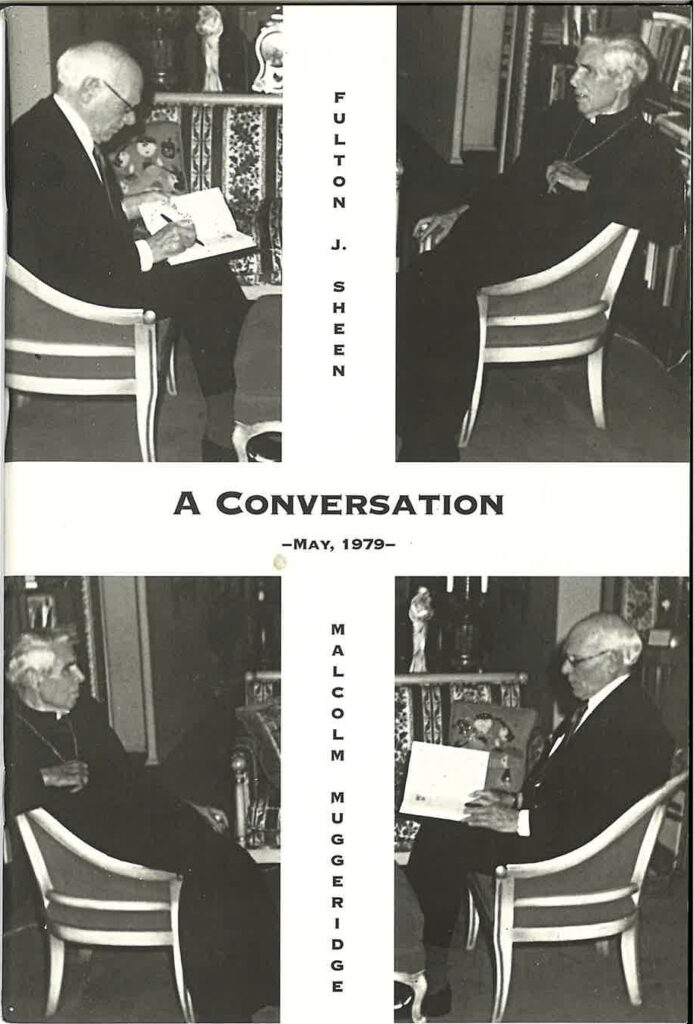
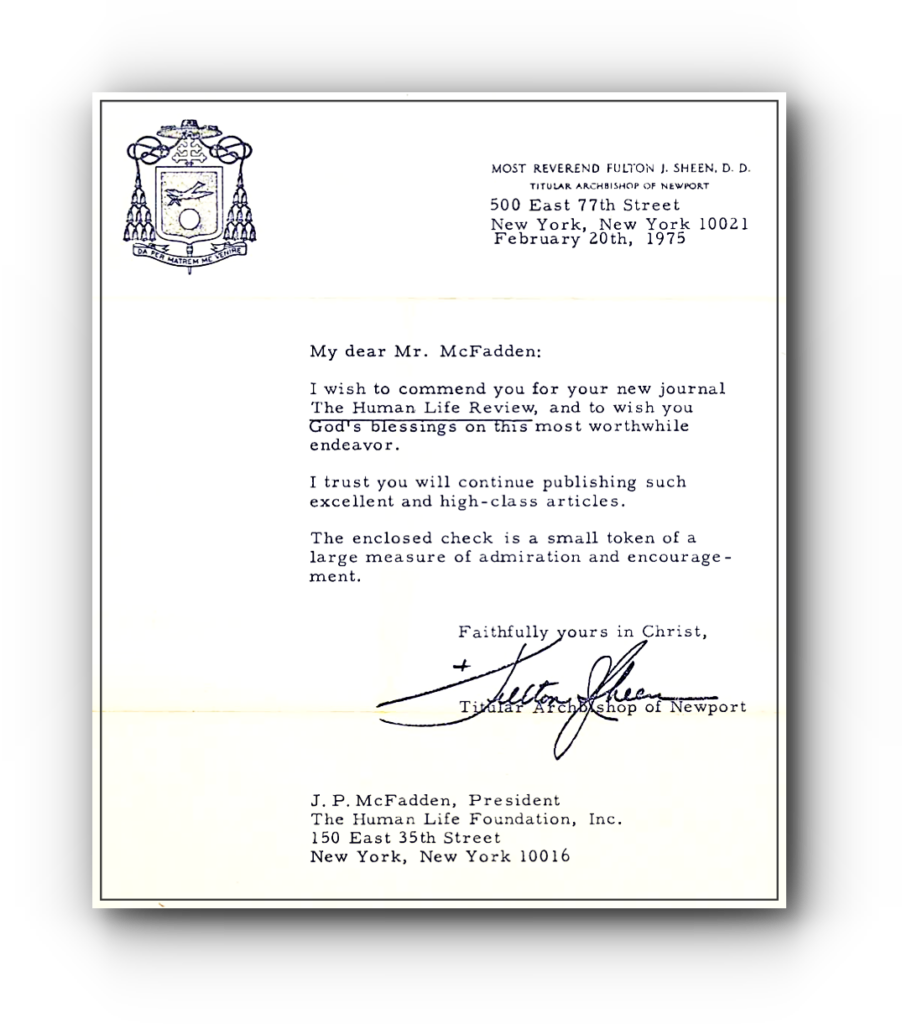
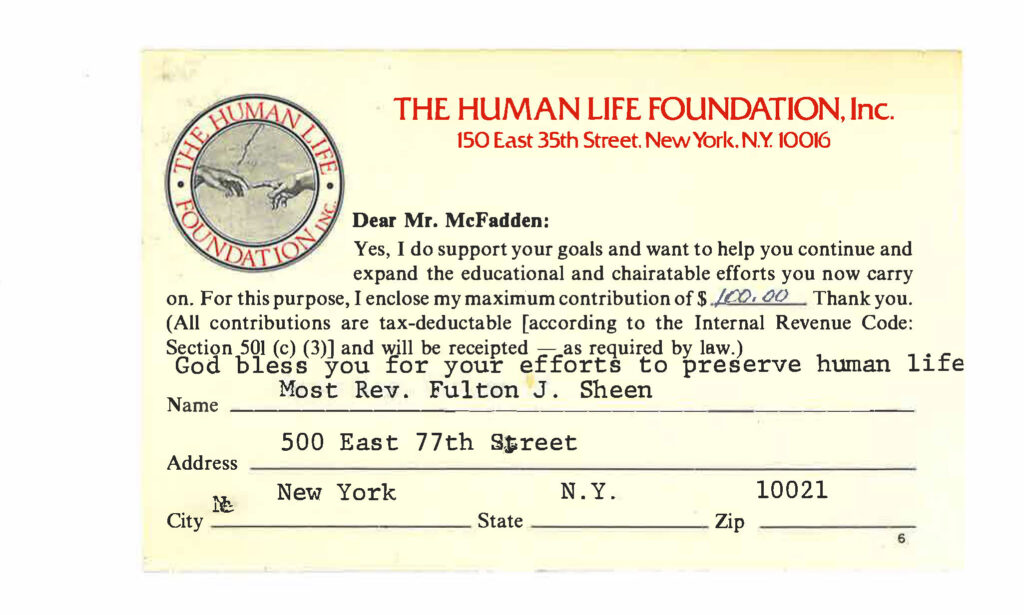
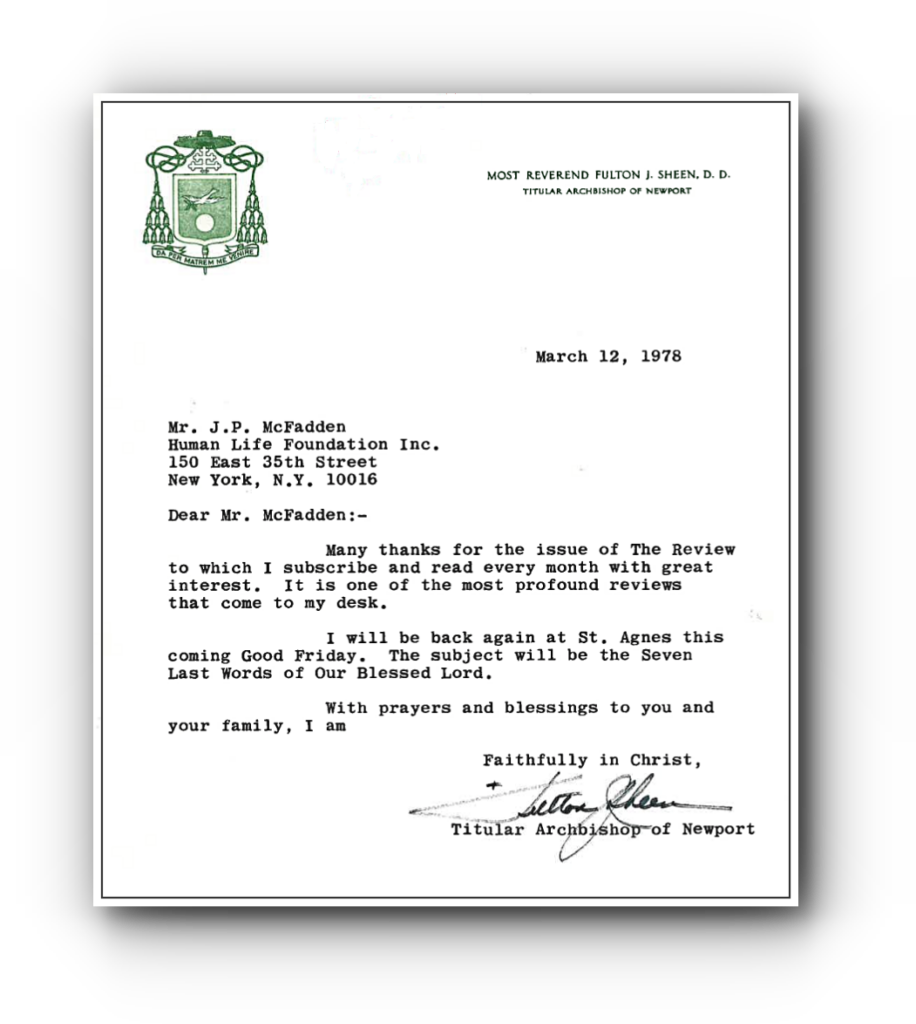
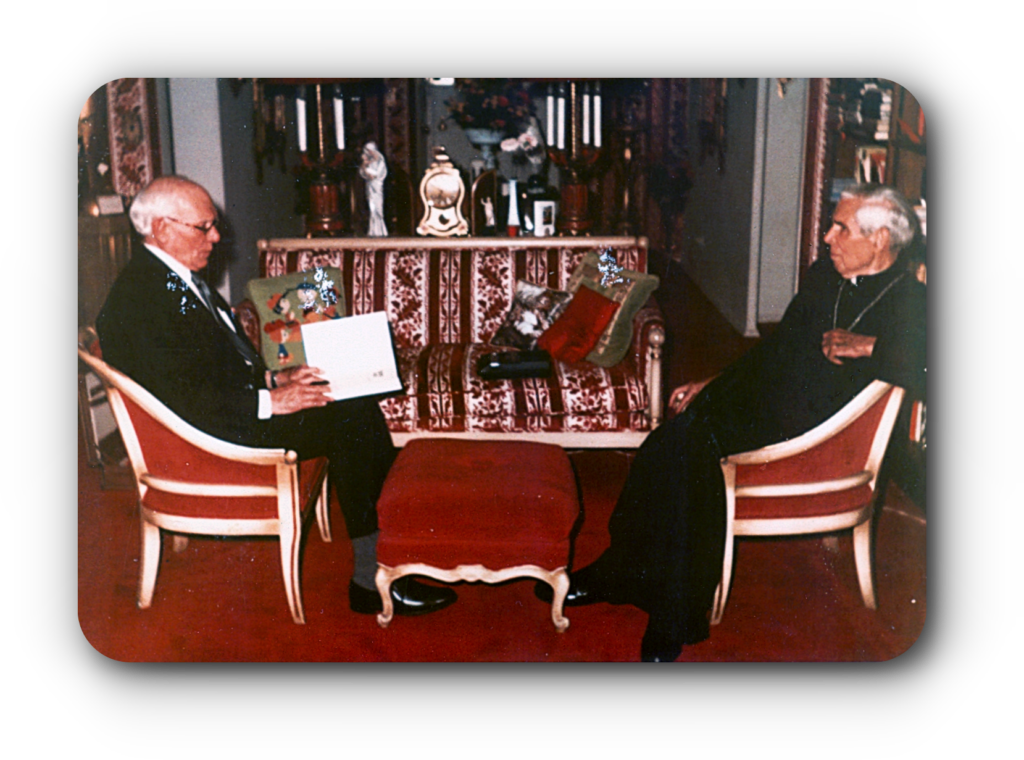
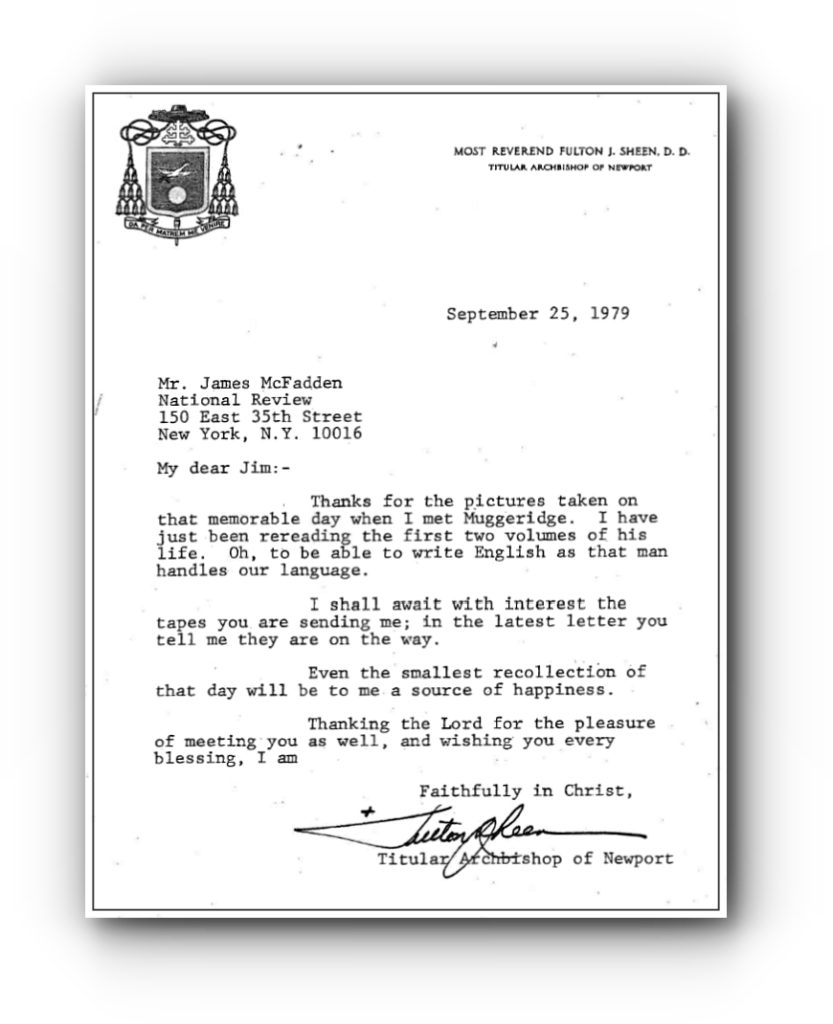
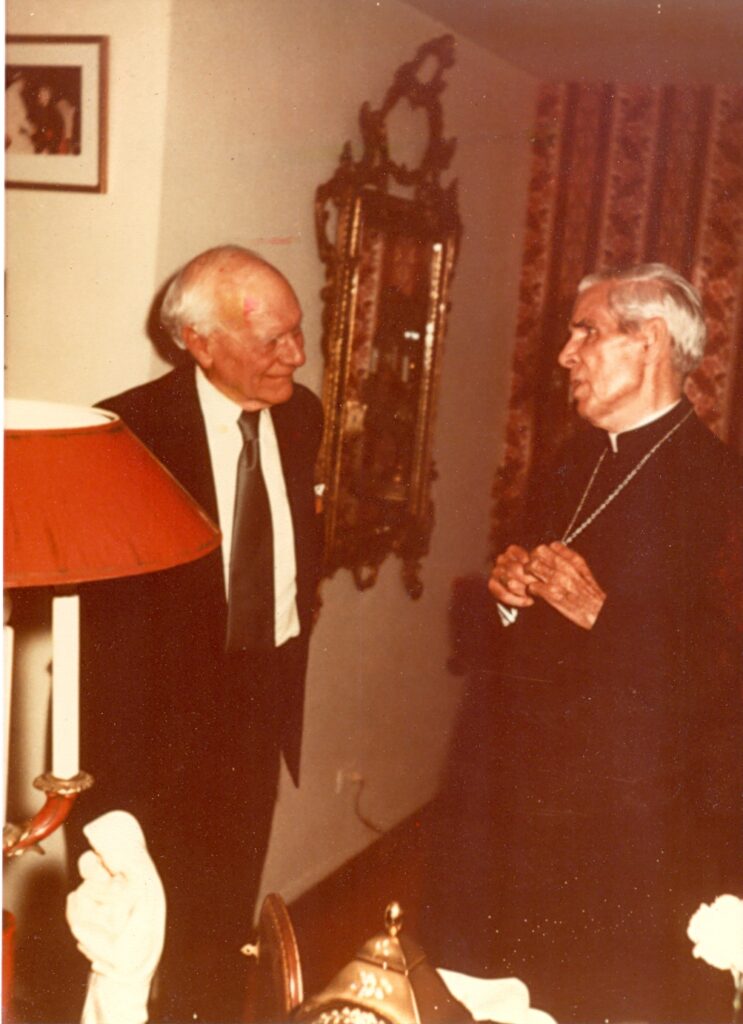
-
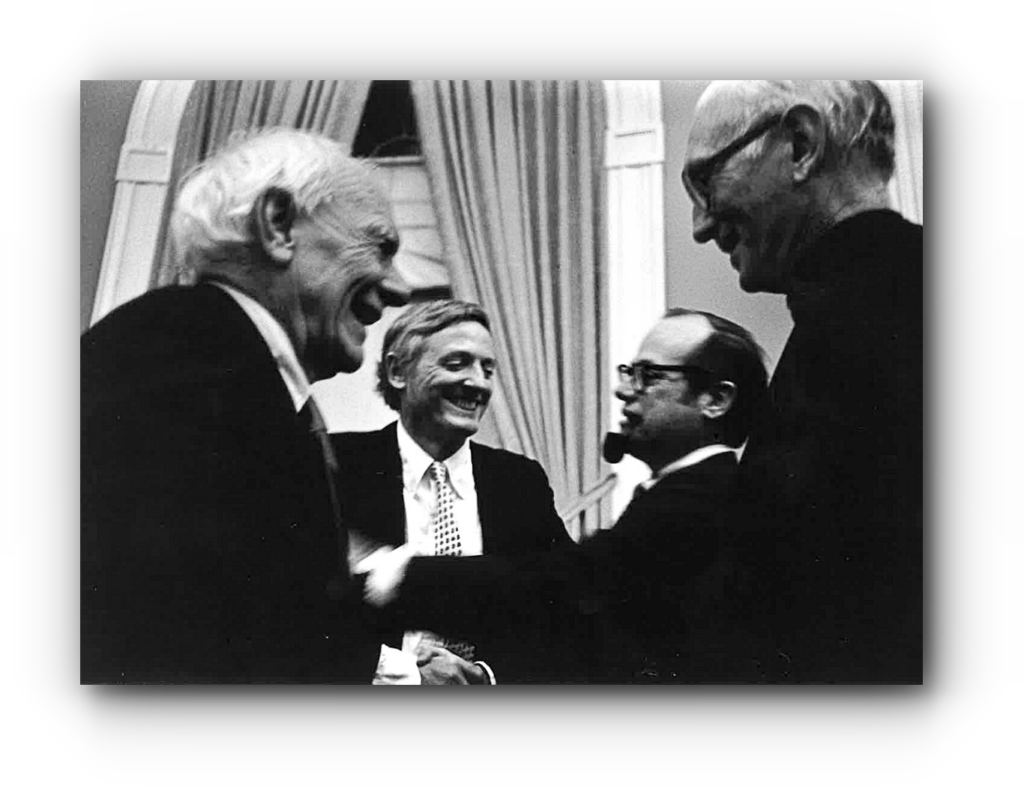
- Malcolm Muggeridge, William F. Buckley Jr., J.P. McFadden, and Fr. Francis Canavan at McFadden’s 1979 Testimonial Dinner
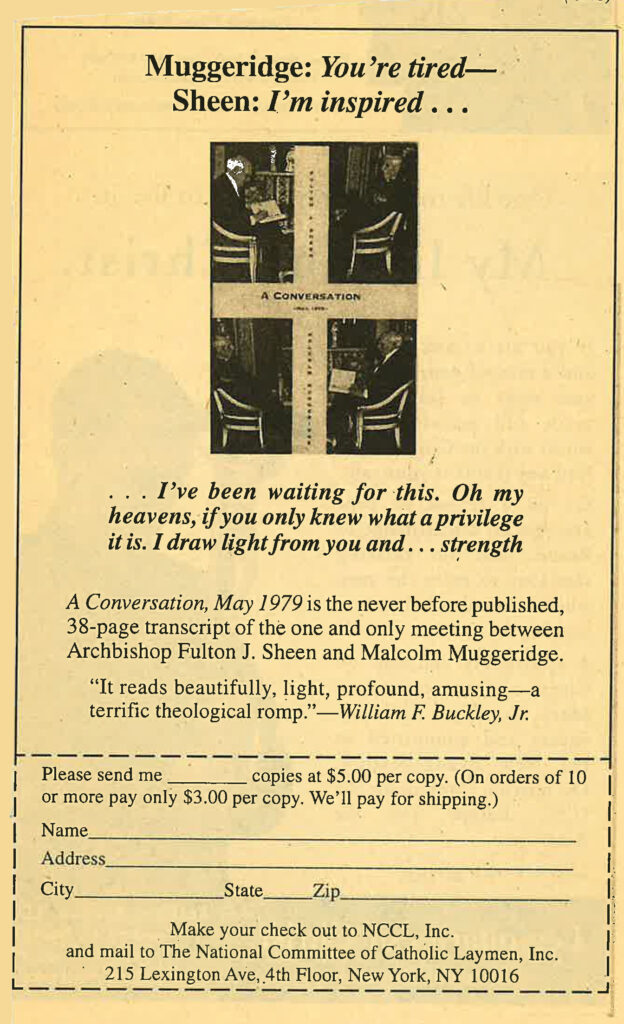
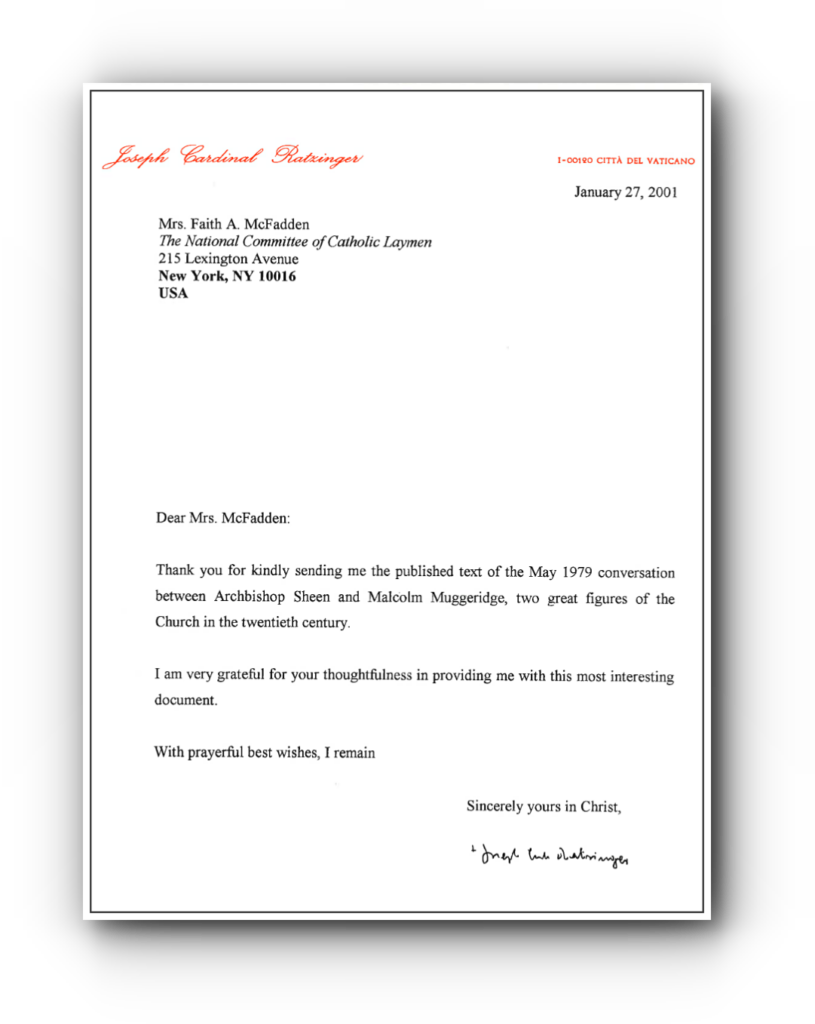
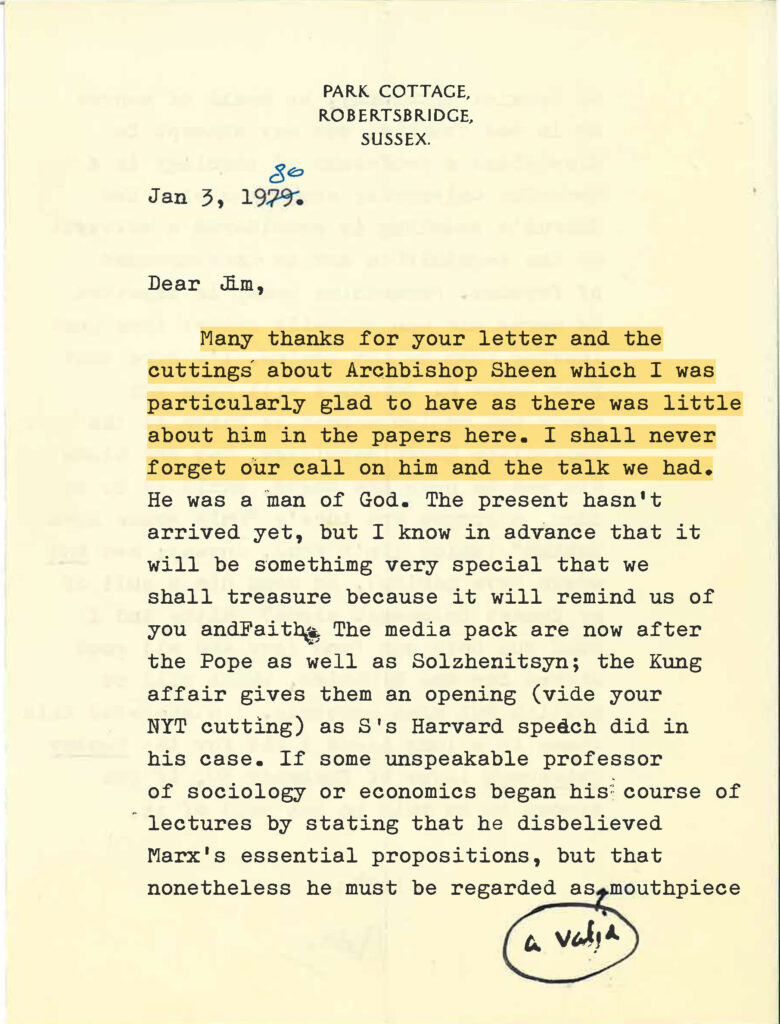
Bios (compiled by Ellen Wilson Fielding)
- Anne Roche: Canadian Catholic married to Malcolm Muggeridge’s son John, she chronicled the post-Vatican II Catholic Church in The Gates of Hell (1975) and The Desolate City (1986; rev.1990).
- (St.) John Henry Cardinal Newman (1901-1890): English Catholic priest, cardinal, theologian, academic, writer, and poet. One of the leaders of the Anglican high church Oxford movement, he converted to Catholicism in 1845, describing that conversion in his Apologia Pro Vita Sua. The Dream of Gerontius is his poem depicting death, judgment, purgatory, and paradise.
- Msgr. Ronald Knox (1888-1957): English convert to Catholicism, Knox was a priest, theologian, author, and translator of the Bible.
- St. Teresa of Avila (1515-1582): Spanish Carmelite mystic and (with St. John of the Cross) reformer of the Carmelite order, she wrote The Life of Teresa of Jesus, The Interior Castle, and The Way of Perfection.
- Aleksandr Solzhenitsyn (1918-2008): Russian author, dissident, and political exile awarded the Nobel Prize for Literature in1970 for novels incorporating his experience of the Soviet political prison system such as One Day in the Life of Ivan Denisovich and The First Circle; The Gulag Archipelago is his three-volume compilation of information about the Soviet political prison system.
- Graham Greene (1904-1991): English writer, journalist, and Catholic convert whose novels include The Power and the Glory, The Heart of the Matter, and The End of the Affair.
- Evelyn Waugh (1903-1962): English Catholic convert and author of novels such as Brideshead Revisited, as well as biographies and travel writing.
- Alec Vidler (1899-1991): Anglican priest, theologian, and ecclesiastical historian who collaborated with Malcolm Muggeridge on a five-part BBC television documentary and resulting book on St. Paul (Paul, Envoy Extraordinary).
- Comintern (or the Communist International): an organization founded by Lenin and in operation until 1943, whose purpose was to promote worldwide communism.
- Anatoly Kuznetsov (1929-1979): Russian Soviet writer and defector to England whose most famous work, Babi Yar: A Document in the Form of a Novel, draws on his eyewitness experience of atrocities against Jews and others under German occupation in World War II.
- Henry Kissinger (1923-2023): American diplomat, political scientist, and Secretary of State under President Richard Nixon who with North Vietnamese negotiator Le Duc Tho was controversially awarded the Nobel Peace Prize in 1973 for negotiating the cease fire ending the Vietnam War.
- Arthur Koestler (1905-1983): Austro-Hungarian-born author and member of the German Communist party in the 1930s who then became disillusioned with totalitarianism. His most famous novel is Darkness at Noon.
- Maxim Gorky (1868-1936): Russian socialist author whose career overlapped the latter years of Tolstoy and Chekhov, continued through the Bolshevik Revolution and his early support of Lenin, moved into his later exile, and ended with his return to the Soviet Union at Stalin’s invitation in 1931.
- Ilya Ehrenburg (1891-1967): Secular Jewish Soviet writer and journalist who wrote, “You could cover the whole earth with asphalt, but sooner or later green grass would break through.”
- Clare Boothe Luce (1902-1987): American author, playwright, conservative public intellectual, convert to Catholicism (through Bishop Sheen), and wife of Time and Life magazine Editor Henry Luce (1898-1967).
-
Archbishop Edward T. O’Meara, who was national director of the Society for the Propagation of the Faith from Dec. 1966 to Jan. 1972 (succeeding Archbishop Sheen, who had been appointed Bishop of Rochester).
- Peter the Logician: Briefly reigned as Pope John XXI from 1276-1277. In addition to his theological and philosophical studies, he was devoted to the study of medicine.
- Edmund Husserl (1859-1938): Austrian-German philosopher, founder of phenomenology and influence on the philosophical thought of Edith Stein and later Karol Wotyla (Pope John Paul II).
- Albert Camus (1913-1960): French philosopher of absurdism (though often associated with existentialism) and author of novels (including The Stranger and The Plague), essays, and plays.
- Jean-Paul Sartre (1905-1980): French existentialist philosopher, author, and playwright.
- James Reston (1909-1995): American journalist whose career was largely with The New York Times, including many years as a national correspondent based in Washington, DC.
- St. Andrew Bobola (1591-1657): Polish Jesuit and missionary in Lithuania, he was killed by Cossacks in what is now Belarus (which in 1979 was still part of the Soviet Union).
- Leonid Brezhnev (1906-1982): Soviet General Secretary of the Communist Party from 1964 to his death in 1982.
- Nikolai Berdyaev (1874-1948): Russian Orthodox religious and political philosopher who defended the intrinsic worth of each person and condemned totalitarian systems.
- Postulants: Candidates for admission to a religious order.
- Bishop James Walsh (1891-1981): American Catholic member of the Maryknoll missionary order who worked in China from 1918 who was imprisoned in 1958 by the Chinese Communists. He was released in 1970, returning to the United States.
- Humanae vitae (1968) Encyclical by Pope Paul VI reaffirming Catholic Church teaching on marriage, including the illicitness of use of contraceptives.
- Simone Weil (1909-1943): French Jewish philosopher drawn to Christian mysticism and attracted to Catholicism, but remaining outside of the Church at the time of her early death from tuberculosis in August 1943.
- Henri Bergson: (1859-1941): French Jewish philosopher who argued the superiority of immediate experience and intuition over rationalism and science in comprehending reality. Although he stated in his will his desire to convert to Catholicism, he refrained from doing so beforehand due to the possible effects on his fellow Jews and on the Church in Nazi-occupied France.