


ABOUT THIS ISSUE

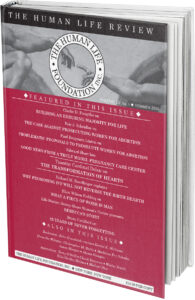
In his lead article, “Building an Enduring Majority for Life,” Clarke Forsythe surveys post-Dobbs America and promotes a path forward. “The Dobbs decision moved control of abortion from the Court to public sentiment,” he writes; no surprise, then, that in this time of “stark ideological divisions” and two generations of Roe’s negative impact on Americans, the country is sharply divided on abortion. Dobbs sent the abortion question back to the states and the democratic process—so, to majority rule. But “the cause for life in America has yet to launch a concerted and sustained effort to build an enduring majority for life.” We need to “build a movement strong enough to induce politicians to follow.” But how?
In a crucial reminder of how the American republic was constructed, Forsythe de-tails the necessity and potential of majority rule, but with the limits on it provided by our Constitution. He looks to the wisdom of the great President Abraham Lincoln to illuminate how moral passion and the virtue of prudence can work together to turn the tide in the majority, to laws that align with natural law and the promises of the Declaration of Independence. This effort will necessarily take time; “Those who are desperate for immediate success and pursue desperate measures, like prosecuting women for abortion,” writes Forsythe, “will burn out or fade away.”
We hope so, because as Eric Scheidler writes, in “Not Like Any Other Homicide: The Case Against Prosecuting Women for Abortion,” the pro-life movement is being challenged from within by calls for “equal protection”—meaning, prosecuting women for murder. “Once a fringe position in the pro-life movement, calls to prose-cute women are growing,” writes Scheidler. “Former Planned Parenthood manager Abby Johnson, who has a massive online following, is now advocating for these measures in testimony before state legislative committees, insisting that anyone who opposes them isn’t serious about ending abortion.” Of the many compelling moral and practical reasons to oppose such laws is the difficulty in establishing a woman’s mens rea, or state of mind. “After five decades of legal abortion, we know how often women are pressured into abortion by boyfriends, husbands, parents, employers, and others.” What about the abortion providers? With the woman a co-conspirator, she can’t identify him or her without immunity; with immunity, the whole “equal protection” premise falls apart.
Such proposed laws, as legal scholar Paul Benjamin Linton writes next, are “flawed, counter-productive, and probably unconstitutional.” The “pregnant woman herself may be acting under stress or pressure”; and without the assistance of a third party, acting “out of ideological or pecuniary interests or both” she would not be able to have an abortion. “As the more culpable party, the person who makes it possible for a pregnant woman to terminate her pregnancy through an illegal abortion should be the focus of law enforcement.” Linton gives us valuable historical perspective and explains why the advent of mail-order chemical abortions makes the proposal to prosecute women even more unjustified.
In his article, Scheidler asks what “equal protection” laws would do to the life-saving work of pregnancy centers. Women considering an abortion would “avoid them at all costs” of course, or risk arrest. Rather than limit the work of pregnancy centers, what we need is what Edward Short writes next: “Good News from a Truly Model Pregnancy Care Center.” Short shares “the charism and efficacy” of A Caring Center for Women in Vero Beach, Florida, operated by an “extraordinary married couple, Gerri and John Rorick.” Since its 2013 founding, the center has grown exponentially in the number of women seen and the services it offers, including programs for fathers, and medical services like mammograms and STD testing. A Caring Center for Women is truly a model to be replicated.
Short writes that those who establish and sustain pregnancy care centers do so propelled by conscience and a sense of justice, most often based in religious faith. Cardinal Timothy Dolan, who recently retired as the Archbishop of New York, and who will be our Great Defender of Life honoree this year, contributed to a symposium we published in 2012, “Truth-Telling in the Public Square,” which discussed whether prolife arguments ought to be argued from secular or religious terms. We reprint his entry here. “The Transformation of Hearts” is as relevant now as it was then, if not more so. “Our culture is currently undergoing a crisis, in which the sense of God has been eclipsed and people have lost the understanding that they have a responsibility to something higher than themselves . . . The exclusion of religious content from the public square will inevitably lead to the dominion of ethical relativism, in which no human rights can be guaranteed with certainty.”
Should embryos have human rights? President Trump disappointed his pro-life supporters when he promoted and supported IVF, which often destroys live embryos, because, he said, “We want more babies.” Hold on, writes Richard Doerflinger in “Why Promoting IVF Will Not Reverse the Birth Dearth.” The moral issues are clear, but practically, “efforts to address the birth dearth by maximizing the use of IVF ignores three important facts.” Facts that we have not seen put together elsewhere. I won’t give them away because this article is a must-read; but here’s a hint—the lack of babies has much less to do with infertility than you might think. Doerflinger concludes by asserting that the real problem we face with reproducing cannot be solved by the government, but by “a revived appreciation for family, community and values that transcend politics.”
Attending to true human values and marveling at the transcendent is necessary for hope, as Ellen Wilson Fielding writes in her uplifting essay, “What a Piece of Work Is Man.” “Recently,” she wrote, “I have noticed an upsurge in my levels of negative speech and thinking regarding the world and its sorry condition.” A friend suggest-ed she try reciting the Psalms of Praise, and that led Fielding to think of poems that lift the spirits, including Hamlet’s famous “meditation on man . . . (his) awe before the marvelous heights that human beings have been created to attain.” Whereas in science, with AI, in medicine, there is a temporary need to “see through” a person, to get a diagnosis, for example, this two-dimensional look blinds us to the true marvel that is a human. “Appreciating, admitting, wondering at, marveling to be-hold—these are ways of attending to someone in a manner that does not seek to exploit or restrain or reduce or disable that person.” This is a small taste of what is a restorative essay on the dignity of each human life—not “because of what each of us does but because of who and whose we are.”
From despair to the restoration of life and hope—this is “Rebecca’s Story,” in Life Stories, from a pregnancy center on the New Jersey Shore. I’d ask that you pay attention to the large sum the National Abortion Federation was willing to fork out so that this woman could get an all-expenses-paid trip for an abortion! But the center’s director, Tricia Bradberry, reached out with life-saving (this time for mother as well as baby) help; you will read the blessed result.
This September will mark the 25th anniversary of September 11th. Our faithful contributor Brian Caulfield remembers the horror, in “25 Years of Never Forget-ting.” He will never forget: “. . . to us who lived in lower Manhattan, the sights, the sounds, the fear, the horror, the wrack and reek of those days are always close by.” Yet he fears others are already forgetting, or are uncomfortable remembering per-haps, as that day is clouded by “what even close supporters consider a failed after-math: the invasion of Iraq, the search for WMDs, the eight years of war and seemingly endless, repeated tours of duty of a volunteer military.” Still, he says, “9/11 is unique, set apart from whatever followed, a world-historic attack on our homeland that stands as singular as the bombing of Pearl Harbor did for my parents.”
In Booknotes, John Grondelski reviews Abortion and America’s Churches: A Religious History of Roe v. Wade, by eminent historian Daniel K. Williams, who looks at “how religion shaped legal and social attitudes towards abortion.” In this “provocative book worth an engaged reading,” Williams argues that the ideas of three major groups—liberal protestants, Catholics, and Evangelicals—“had consequences for the American debate about abortion” from the 1960’s to Dobbs.
* * * * *
In our collection From the Web, you will read: Christopher Reilly on “doubling down” on faith in arguments for life; Madeline Fry Schultz on a Democratic candidate for Congress who had an abortion “after planning her perfect family size with IVF”; Jason Morgan on the sad story of Wendy Duffy, who sought assisted suicide because of grief over her lost son; and new contributor Alyssa Glasgow on how effective attention to poverty would reduce the abortion rate. Appendices A to C report on MAiD in Canada: Terry O’Neill writes about a priest who was offered assisted death after he fractured his hip; Chuck Donovan shares the better news that a parliamentary committee has recommended not extending MAiD to those suffering from mental illnesses; and Wesley Smith laments the Anglican Church of Canada’s shocking “pastoral liturgies blessing euthanasia.” Back to the U.S. and our last two contributions, Ellie Gardey Holmes shares Planned Parenthood’s new strategies to pump up cash flow, and Michael New, in “Dobbs at Four,” provides his expert analysis of where we are and what challenges we face in the future. Finally, we are, as ever, exceedingly grateful to Nick Downes for his mischievously clever cartoons.
Maria McFadden Maffucci
Editor in Chief
About the Author
 is the Editor in Chief of the Human Life Review