


On Genetic Difference and Our Common Humanity

During a recent interview, journalist Paola Ramos told pronatalist tech entrepreneur Malcolm Collins that there was no scientific evidence to support Collins’ claim that there are genetic differences among Black women and other women affecting pregnancy and fertility. Collins repeatedly defended against Ramos’ assertion, but Ramos doubled down. There is no scientific evidence, she said again, that there are any genetic differences among people of different races. Ramos implied that such arguments are redolent of eugenics.
For the record, I want to make clear that it is absolutely scientifically true that there are genetic differences among different groups of people. As Malcolm Collins struggled to convey to his interviewer, genetic differences can indicate different sets of problems pregnant women may face.
There are, to be sure, disparities in health care varying by race, but this is a social issue. Whether someone of a certain race is more or less likely to have health insurance or to have access to quality medical services is a function of how human beings structure their social interactions. The same holds true for eugenics-based abuses of the human person. Ramos was not incorrect to point out that people have made, and still do make, determinations about human worth based on genetic differences. But these determinations, too, are social. The bottom line is that prejudice is not scientific. Racism is a failure of morals, a refusal to love, and not a biologically-determined fact of human relations.
What Collins means, and what I also wish to stress here, is that there are genetic-level differences that can affect health in individuals. Tay-Sachs disease for Ashkenazi Jews, for example, sickle cell anemia for Blacks and Latin Americans, cystic fibrosis for Caucasians, and even diseases more prevalent among Puerto Ricans and Finns. These are scientific realities. From hair and eye color to susceptibility to serious disease, we humans are, undeniably, genetically diverse.
But in the impromptu debate between Ramos and Collins on genetic difference there was hidden a much more profound truth than the one to be found at the level of chromosomes and alleles. When one stops to think about it, one is forced to conclude that genetics, while important for human health and development, is not determinative of humanity. Our humanity is not in our DNA. Our genes reflect our humanity–they dance, as it were, to the human song–but do not constitute the shared human nature that binds us all into one human family.
I can make the statement even stronger: humanity is in no properties whatsoever. There is nothing that a human being may have or not have genetically that makes him or her any more or less of a human being. No matter what the genetic makeup, all humans are human. So, the essence of humanity must lie elsewhere. Some humans are autistic. Some have Down Syndrome. Some are short, some are tall. Some are born without arms or legs. Some have cleft palates. Some have weak hearts. Some have cerebral palsy. Some are color-blind. Some are deaf. Some have no wisdom teeth. Some have missing organs. Some have missing melatonin in their skin. The genetic differences among us can be of great consequence. But genetic differences affect humanity precisely zero. No matter the genetic differences, you and I are of one kind. Humankind. Genetic differences have no ability to affect this bedrock fact.
This is a truly astonishing thing to realize. Take some time to think about it. You and I, and everyone else, are not fellow humans because of what we physically look like. We may have most genes in common, just as we have most genes in common with chimpanzees. But for all that, we are, each of us, standalone masterpieces in the universe. Not only are racial groups unique. Each human person is genetically unique, too. Except for identical twins, all humans have a DNA fingerprint that is shared by no other human anywhere. And even in the case of identical twins, epigenetics, or the way in which DNA expression changes depending on other factors beyond the DNA strand, can lead to big differences in body and mind. From the moment of conception, genetic material from a mother and a father combine and are transformed into the genetic array of a one-and-only human being, similar to, but at the same time fundamentally unlike, his or her mother and father.
So, you are not me, and I am not you. And yet, we share something more powerful than anything that any gene could determine. We are all human not in spite of our genetic differences, or because of them, but at a level far, far beyond the inner workings of cells inside of our physical bodies. What our genes code for is not humanity, but expressions of a humanity that transcends both our genes and each one of us.
Genetic difference was the topic of a livewire debate that went viral on the internet, but genetic difference is really a very small part of the story. The main theme is that we are humans, all. We are made in the image and likeness of God. That is what makes us all brothers and sisters. Genetic difference is not something to get stuck on. What connects us is infinitely more important.
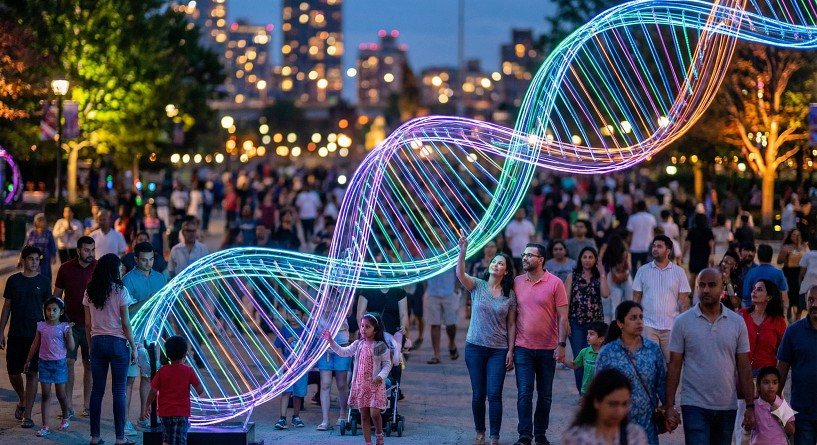
Generated with Google Gemini