

Resurrection Scars

The gift of life has a paradoxical heart, in that the lives we have been given are, every one, mortal lives. I speak here as a Christian: to be a witness to life entails witnessing to mortal life, life that ends in the sadness and pain of death. Nonetheless, at a funeral a priest may say: “To your faithful people, O Lord, life is changed, not ended.” The normal Christian view is that death separates the soul from the body; that God preserves the soul from dissipation or annihilation; and that in the future there will come a day when human bodies are resurrected, rejoined with their souls, and those who love the Lord will then join in eternal praise of him in heaven. There we will be truly human, which is to say, we will have bodies as well as souls.
One may ask: What kind of body is this resurrection body?
Rather than turning to philosophy, let’s consider the question with the aid of C. S. Lewis’s so-called “dream,” The Great Divorce. We could ask, for starters: Will the resurrected body be lustful?
It is clear that any vice must be excised before one can enter heaven. But vices are not merely thrown away; they are transformed into virtues. Lewis in his “dream” sees a lustful man who has arrived at the very beginning of the foothills of heaven. His lust is depicted as a little red lizard that sits on his shoulder and whispers into his ear. The lizard says, we really shouldn’t stay; this isn’t the place for people like us; we can go back to the Grey Town (which will ultimately be hell). The lizard promises to be very good, he insinuates that no real man could live without lust, and so on. It’s not hard to write the story. But when this man apologizes to the bright spirit who has come to greet him, saying that he really can’t enter with this lizard on his shoulder, the bright one says, in effect, you’re right: Would you like me to kill it? The man lacks power in himself to destroy his lust, but nonetheless he has freedom to say yes or no to the bright spirit killing. After great agony, he finally consents. It is accomplished immediately and with pain. But then comes the surprise. The lizard indeed dies but then, out of its corpse, there springs a strong red stallion; the man leaps upon the back of the horse and bounds ahead, over the ever-ascending hills into the high country.
Lewis wants us to see: Every vice must be excised; the resurrection body can suffer no such affliction. But the excision of any vice will give birth to new virtue. Lust, for instance, will turn into eager and abundant love, cowardice will turn into courage, and so on for each of them. The elimination of vice does not leave behind bland characters, each the same as everyone else; rather, it makes us even more distinctively ourselves. To become a saint is not to lose personality or difference or distinctiveness. To the contrary: sanctification is an individuation process.
So the resurrection body is in no way disfigured by vice. Still, the visual marks that sin leaves behind might well endure. If so, then they will be born in heaven gladly, for they will be tokens of the goodness of God.
The resurrection body will have scars—perhaps of sins overcome, perhaps of wounds borne for the sake of Christ. We cannot know, concretely, what this will mean. Might a saint who was beheaded for his fidelity to Christ carry his head in his arms in the resurrection body? There are statues of Saint Denis holding his head, and there is even a word—cephalophore—for saints who pick up their heads and carry on. Whatever we might say about that, it is the case that the scars we bear in this life can become part of our eternal glory. A true picture of glory will include signs of “imperfections,” marks of our actual life’s journey.
The key instance of this is given by Jesus himself. His own glorified body in heaven even today has the marks of his crucifixion. There is no pain from these marks. Jesus doesn’t bleed from his scars—his blood has been shed once for all. But the body that shed it shows forever that it did shed its precious blood. Saint Thomas, one week after the resurrection, was the first of many who have been permitted to see this marvel, that the perfect body of Jesus has glorious scars.
This is a consistent biblical theme. Jacob has a limp that he bears to the end of his days: it is a sign of God’s blessing of him, and I think his limp foreshadows Jesus’ scars. It’s also a theme we know from ordinary life. A woman who has given birth may bear signs for the rest of her days of what she has gone through: signs of love they are. If you pushed your child out of the way of boiling water and had that water fall on your skin itself, you bear a sign of love. These are not shameful signs, and in truth they are not imperfections; we should not be ashamed of them or turn away from them. It is a glorious thing, dear reader, that our bodies “show their age” and gradually wear out. It is a glorious body that bears the signs of a life lived in love.
In addition, your body may bear scars of your own sins. These too could become, in heaven, loci from which praise rises to God for his forgiving love and resurrecting intent.
Many wise people say that to become a saint is to become completely yourself, with your unique God-given identity and your unique concrete history. This means that many of our everyday images for heaven are too tame, too shallow, too sweet. Heaven will be filled with all sorts of people that our fallen world pushes out of mind. Our fallen, post-industrial world which spends zillions of dollars on medicine hides from view people who are not “beautiful” in the way that captures “likes” on social media. Heaven will be much more diverse in its bodily forms. There will be, I think, humans there of all sorts, with scars and “defects” which, however, will not be subtractions from their ability to be fully human. I don’t know if Saint Denis still carries around his head, but I look forward to greeting him—and perhaps, with Saint Thomas, seeing the glorious scar in the side of our dear, resurrected Lord.
About the Author
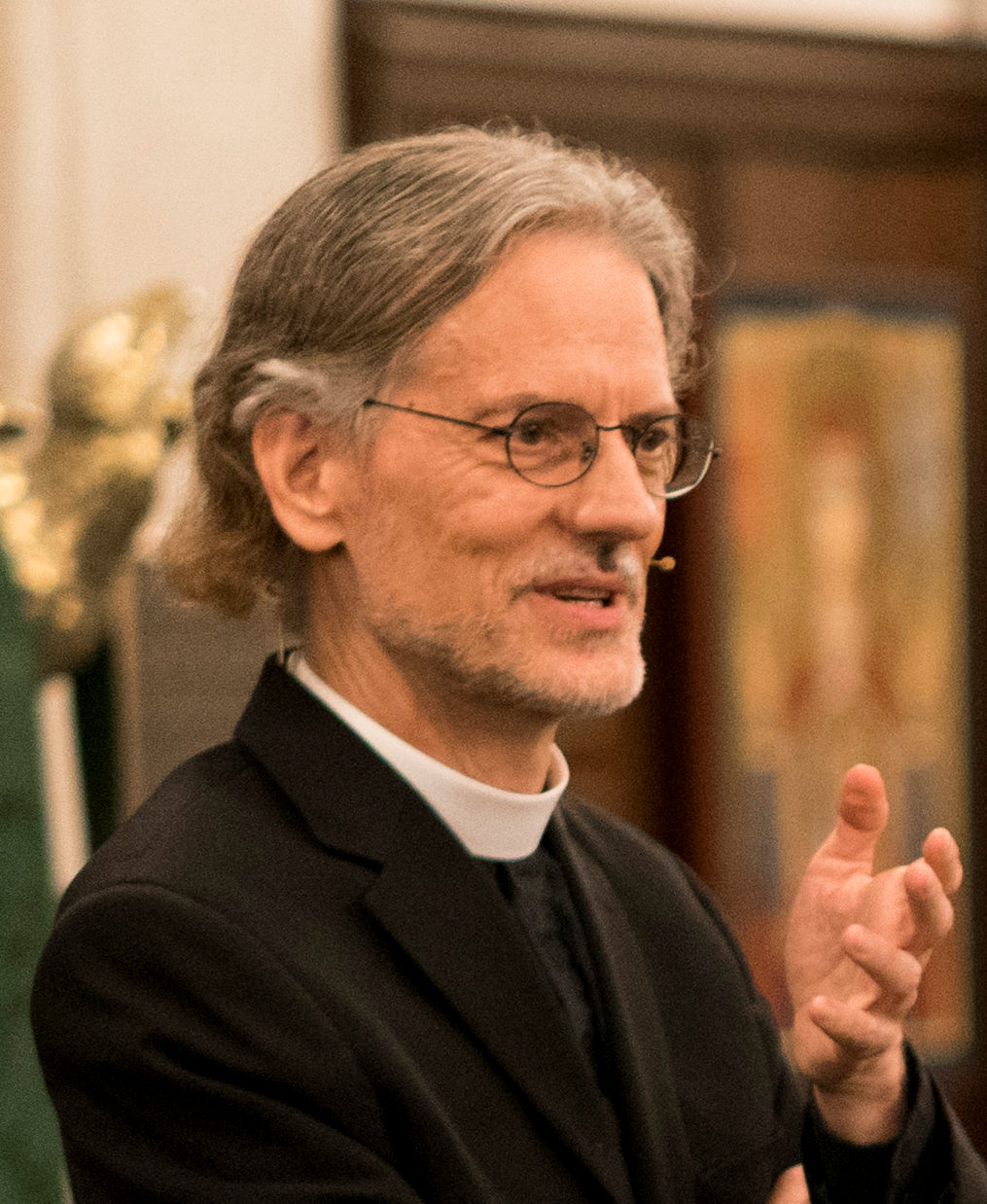 The Rev. Canon Victor Lee Austin, theologian-in-residence for the Episcopal Diocese of Dallas, is the author of a handful of books, including Friendship: The Heart of Being Human.
Bio current as of January 2026