


The Mystery of the Cross

In the year 1219, Pope Honorius III gave the Roman basilica of Santa Sabina on the crown of the Aventine hill to Saint Dominic, to be a church of the Order that Dominic had founded—as it remains today, the Dominican “mother church” in Rome.
S. Sabina was built in the mid-5th century. It has a tall, rectangular, pillared nave, light and elegant, relatively unadorned. And it has a wooden door, intricately carved with Biblical scenes, that is as old as the church itself, and on this door is carved the first known crucifix in Christian art.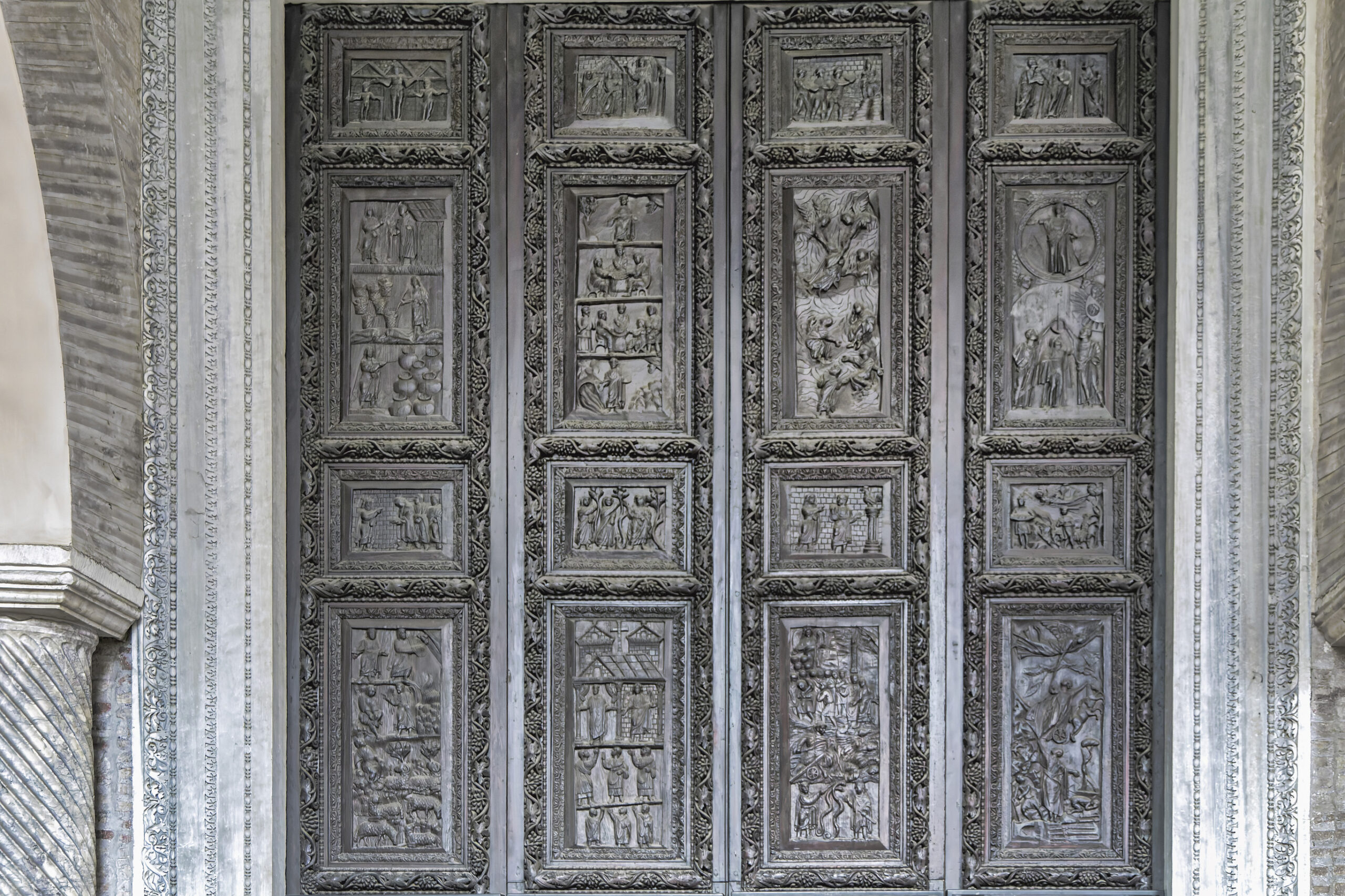
One of my professors in Rome was showing me this door of S. Sabina and I asked him, “Why does this earliest known crucifix date from as late as the 5th century? Didn’t Christians venerate the image of Jesus crucified from the very beginning?”
“Yes,” my professor replied, “of course they did. But until the emperor Constantine mercifully abolished crucifixion in the early 4th century, people could see live crucifixes outside any Roman town.” People could see real men hanging naked, bleeding, dying on their crosses, just like Jesus—living crucifixes just as easily visible to Christians, up to the first decades of the 4th century, as carved crucifixes are to us in churches and in wayside shrines today.
The Roman catacombs contain secret icons of the Cross: the image of an anchor (an upside-down Cross, a symbol for hope) or the Chi Rho (a monogram of the first two Greek letters of the word for “Christ” in the shape of a Cross), showing that the first Christian generations did venerate that thing whose awful actuality was part of their everyday environment. They could hold together in their faith the horror of the Cross of Jesus that they saw and felt around them, and its exaltation as the object of their worship, remembering the words of Jesus: “I, if I be lifted up, will draw all men unto me.” (John 12:32)
Catholics celebrate the feast of the Exaltation of the Holy Cross on September 14. It is an ancient feast, originating from the mother of the emperor Constantine, St. Helena, bringing relics of the true Cross home from Jerusalem to Rome, where they may still be venerated in the basilica of S. Croce. From that time, it was no longer necessary for Christians to venerate the Cross in secret, in the symbols of the Chi Rho or an anchor. Now, it is the actual wood that we venerate—the blood-stained wood on which our tortured Savior died. We venerate the horror of it, as we celebrate our Savior’s exaltation on it.
Jesus tries to explain his Cross to the faithful rabbi Nicodemus in the gospel for this day. Crucifixion inspired a special kind of horror in the minds of pious Jews, for to them it was a curse. It was not just natural horror at the sight of cruel torture; it was religious horror, for they saw a man crucified as cursed by God. So, to the Jews, as St. Paul says, the Cross of Jesus was a scandal, a stumbling-block to believing that Jesus was from God, much less was God. But St. Paul could even say that God in Christ became “a curse for us.” (Galatians 3:13)
Now, Jesus makes a fascinating argument to persuade Nicodemus that his Cross, this curse, could be an instrument of healing and salvation for the world. A rabbi, of course, would be familiar with the story of the Exodus. He would know about the curse of poisonous serpents that afflicted the people when they sinned against the Lord. He would remember how the Lord instructed Moses to make an image of a serpent, mount it on a pole, and hold it up before the people: when they looked on it, which was their curse, they would be healed; they would have forgiveness and new life.
Jesus says to Nicodemus: consider, now—the serpent was a curse, but such is the power and mercy of God that this sign of their curse, held up before his sinful people, becomes the instrument of their salvation, healing, forgiveness and new life. So, our Lord concludes, “so must the Son of Man be lifted up [as a curse] so that everyone who believes in him [as Son of God] may have eternal life.” (John 3:14)
Though he couldn’t claim to understand it, this fascinating explanation seems to have persuaded Nicodemus, for we know that he defended Jesus in a conflict with his fellow-Pharisees (John 7:50); and we know that he was there with another faithful Jew to take the body of Jesus down from the Cross and give it decent burial. (John 19:39)
Still, Nicodemus remained a secret believer, coming to Jesus under cover of darkness, both at their first meeting and their last. I think he continued to be struck with the tremendous mystery of what the Lord had told him—that the Son of God would make himself a curse, lifted high upon a cross before the world, in order to remove the curse of sin and death from the world that God so loved. That is the measure of God’s love for us: that he, forever blessed, should make himself a curse for us.
And that was a tremendous mystery just as much for Christians of the first three centuries as it was for Nicodemus, and as it is also for us. The visibility of living crucifixes gave them no advantage over us in comprehending the Cross of Jesus, because, after all, the measure of the love of God is not so much his visible suffering, as his embrace of us to the very depth of our condition, under the curse of sin and death.
That is why we exalt the holy Cross and lift it up before the world: with St. Paul the apostle, “we preach Christ crucified, a stumbling block to Jews and folly to Gentiles, but to those who are called, both Jews and Greeks, Christ the power of God and the wisdom of God. For the foolishness of God is wiser than men, and the weakness of God is stronger than men.” (I Corinthians 1:23)