


Patience and the Art of Dying

The pro-life sensibility extends beyond the manifest beauty of a baby and the awesome realities of prenatal life. It extends beyond the intricate, sometimes self-sacrificing, and perduring interconnections of mother and child. Indeed, the pro-life sensibility extends through the processes of aging and suffering all the way to the end of life. The pro-life sensibility recognizes that there is something essentially human in sickness and in the various debilitations and pains that generally, though not always, accompany us as we move towards our earthly end.
In the past few generations, in the wealthier parts of the world, the path that most people take towards death has radically changed. Dying has been overtaken by medical urgency to fight off disease and to extend health. The metaphor of “fighting” disease is universal and generally used without conscious thought. But it disguises a contradiction in our thinking. We know we are mortal and are going to die someday. We really don’t want to live forever on this earth; indeed, for humanity as it is (a Christian says, for “fallen” humanity), the idea of unending life is about as accurate a picture of hell as one could have. Nonetheless, the way we approach medicine requires us not to think about that. Our attention is always given to fixing another body part that is giving us trouble; to fighting off a cancer for another five years; to having new joints, new implants, new drugs, and so on.
The story is told in Nicolas Diat’s book about monks, as he says, on the edge of eternal life (A Time to Die). There was an elderly monk who went to the hospital for treatment of lung disease. He was nearly 100 years old. The doctors fought his disease with everything they had, and after some weeks released him to go home to the monastery, pronouncing him cured. Indeed, he was cured of the disease, but the rest of him had been so weakened by the treatments that he died two days later. I doubt that my readers will have difficulty supplying similar examples.
While grateful for much that modern medicine has given us, the pro-life sensibility knows that there is good to be found in the process of dying, good that is fundamental to our human dignity. It is because of that good that we oppose the denial of our mortality that is sometimes implicit in modern medicine. Similarly, as L. S. Dugdale has pointed out in The Lost Art of Dying, this good to be found in the process of dying is short-circuited by physician-assisted suicide and euthanasia. But what is the good to be found by going through a dying process, particularly since that process is often painful and difficult?
Traditionally, several goods are noted, such as faith, hope, patience, humility, and charity. Dying persons would be encouraged to practice these things, as best they could, while they had time to do so. These goods arose to combat typical temptations that we humans face as we encounter the limits of our mortal life, temptations of doubt, despair, impatience, vainglory, and avarice. A lot could be said about each of these. But in this space, at this time (which is the beginning of Lent for many Christians), I think the good of patience is worth special attention. Let us consider patience not only as one is close to death but also patience whenever sickness has laid us low. What is this good of patience, and why is it good?
I take as our guide Jeremy Taylor who in 1651 published The Rule and Exercises of Holy Dying. Taylor’s first word on patience is directed at the friends and visitors of the sick person. Don’t tell sick people to suppress their sighs, groans, humble complaints, or dolorous expressions. When you are sick you do not have the duty of being cheerful! Different people feel pain to different degrees, and one should allow a sick person to cry out when pain is severe. Indeed crying out may be helpful, in that in some cases it abates or diverts the pain. The point is clinched by Scripture: Jesus himself on the cross “cried out with a loud voice and resolved to die, and did so.”
Christian patience does not forbid complaint but it should shape the way sick people complain. First, our complaints should be without despair. Complain you may, but do not lose hope. Why? Because God really is good, as we know already from our experience. So pray to God to help you; turn to spiritual guides; make use of “holy exercises and acts of grace” that are proper to a state of sickness.
Second, our complaints should be “without murmur”! Murmuring is what the fallen angels did: they murmured against the way God had arranged things. Instead, think on God’s justice, wisdom, mercy, and grace. Confess your sins, for by doing so you increase and exercise humility. Sing God’s praises—even from the lowest abyss.
And third, our complaints should be without peevishness, that is to say, we should be civil and decent towards people who are ministering to us. Seek to be tractable, easy to be persuaded, apt to take counsel. Don’t be ungentle and uneasy to the ministers and nurses that attend you, and bear their accidents contentedly and without disquietude or evil words.
Finally, there are many things that people who are dying or very sick can still do, even if they are not able to leave their bed. First there are many truths that it is beneficial to contemplate:
(1) Others have suffered worse, many of whom were weaker than we are, and some of them children.
(2) A person endures sickness only one minute at a time. Our duty to endure extends only to the present minute. “One minute at a time,” of course, is akin the AA mantra, “One day at a time.”
(3) Our sickness has a way of putting many other evils in their place. These are things like losses, disgraces, domestic cares, public evils—things we used to think were of great importance, but now we realize they aren’t.
(4) On the flip side, sickness causes us to treasure and love the good things of the world more.
(5) Our personal sickness is not unique; the bravest, the wisest, and the best people in the world have suffered sickness and sad diseases.
(6) Impatience really does no good; it doesn’t take away the pain but instead is hugely effective to the multiplying of trouble.
(7) Present sickness is but for a finite time: If it be sharp, it will not last long; if it be long, it will be easy and very tolerable.
Besides such contemplations, there are deeds we can perform in the midst of sickness, confident that God will provide what we need:
(1) Make an act of thanksgiving, remembering that this pain is not an eternal pain. Bless God for that!
(2) Claim the grace of God that has been given you: in particular, the grace to be able to follow Jesus in the way of the cross.
(3) Resolve to do as much as you can. Never say, I can do no more, I cannot endure this: for God would not have sent it, if he had not known you were strong enough to abide it.
(4) Hold before your eyes and in your heart the example of Jesus upon the cross.
___________________________________________
This column contains a lot of detail, but for all that it is only a teaspoonful of the depth of wisdom contained in what was called “the art of dying” or, in some English versions, “the craft of dying.” There is much that is good here that Western society, in its quest to eliminate all the suffering it can, has largely forgotten. And who is better positioned to recover this old wisdom than those of us who have been given a pro-life sensibility?
About the Author
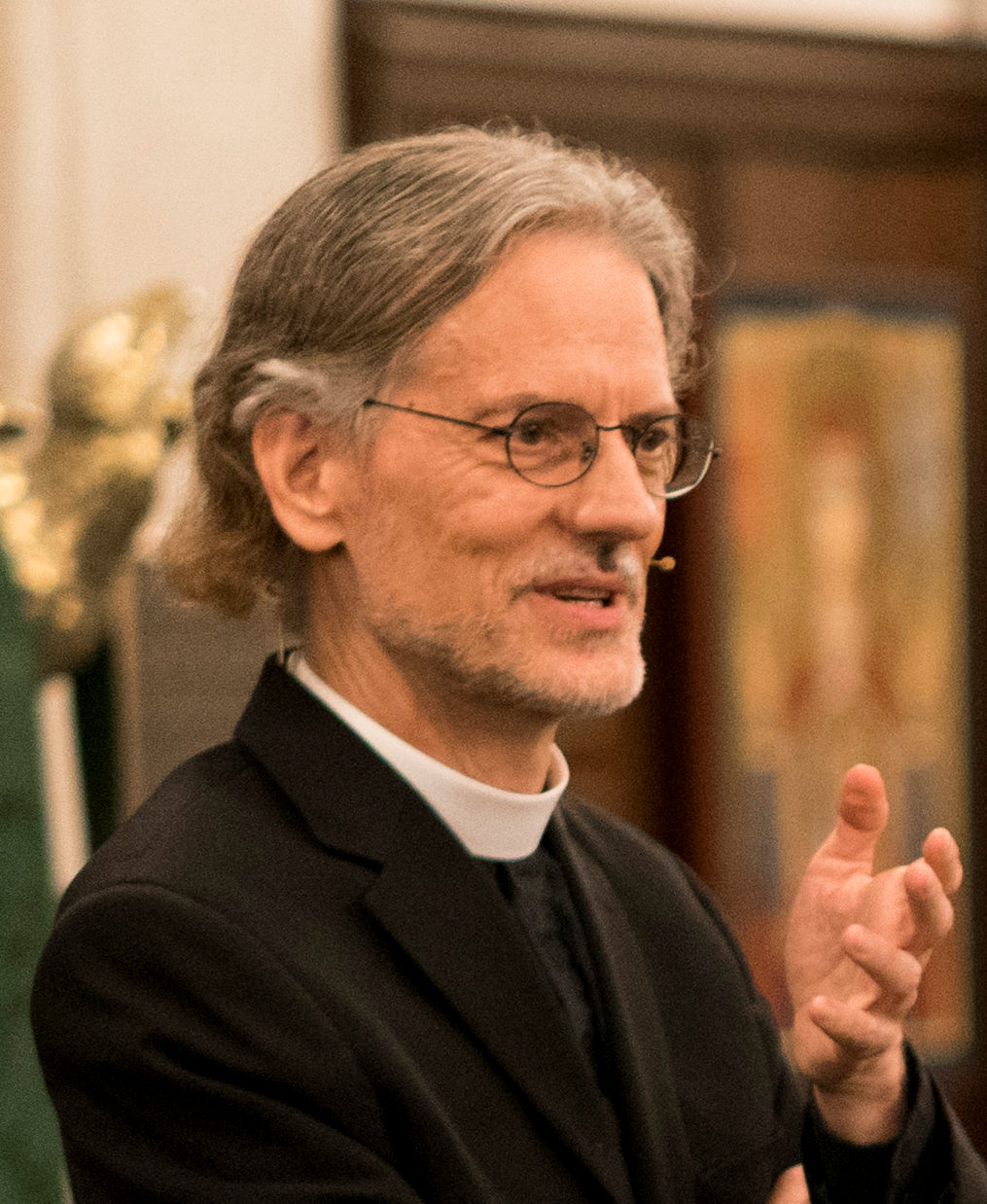 The Rev. Canon Victor Lee Austin, theologian-in-residence for the Episcopal Diocese of Dallas, is the author of a handful of books, including Friendship: The Heart of Being Human.
Bio current as of January 2026